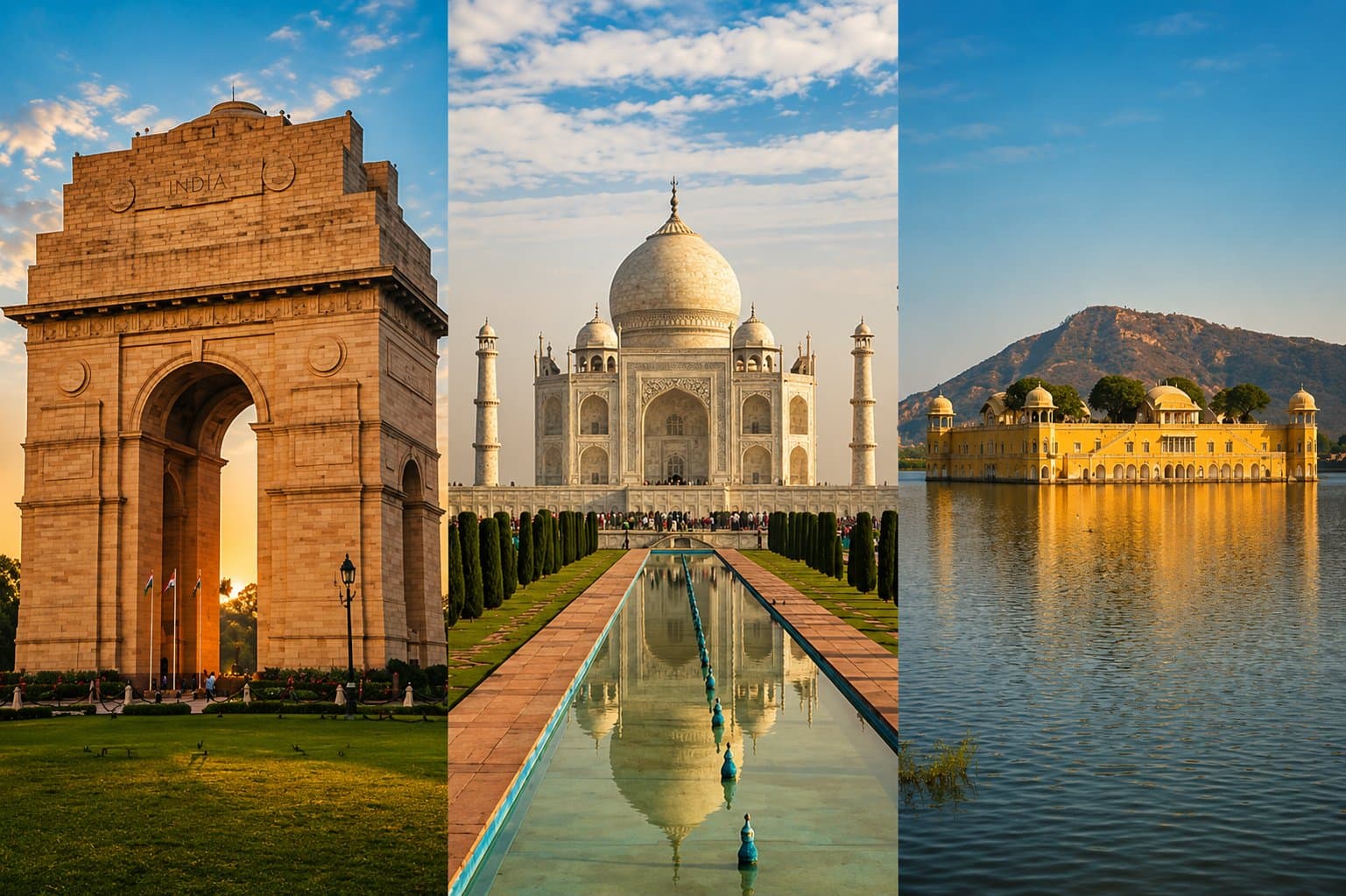
Delhi, Agra and Jaipur together make up India's most-travelled first circuit for a reason — three very different cities, each with a headline monument, reachable in a single short trip without the long internal distances that make a bigger India itinerary harder to plan.
Why This Is India's Classic First Trip
Delhi gives you Mughal and colonial history side by side — Humayun's Tomb and Qutub Minar alongside India Gate and Connaught Place. Agra is built almost entirely around two monuments: the Taj Mahal and Agra Fort, both genuinely worth the detour on their own. Jaipur's Pink City adds Rajput forts, palaces and a living old-city market scene. Between the three, you get a real cross-section of North Indian history and architecture in a compact, well-connected loop — which is exactly why it's the circuit most first-time India visitors, domestic and international, actually book.
A Sample 4-Day Itinerary
Day 1 — Delhi: Humayun's Tomb and Qutub Minar in the morning, India Gate and a drive past Rashtrapati Bhavan and Parliament House around midday, then Chandni Chowk's old-city lanes in the evening for food and the Jama Masjid.
Day 2 — Delhi to Agra: The expressway drive takes roughly 3–4 hours. Arriving by early afternoon leaves time for Agra Fort the same day, with the Taj Mahal saved for sunrise or late-afternoon light the following morning — both are considered the best lighting windows and come with noticeably thinner crowds than midday.
Day 3 — Agra to Jaipur: A roughly 5-hour drive, often routed via Fatehpur Sikri (about 40 minutes off the direct road) if you want to add the abandoned Mughal city as a stop. Arriving in Jaipur by afternoon leaves time for Amber Fort and the Nahargarh Fort viewpoint for sunset over the Pink City.
Day 4 — Jaipur: City Palace, Hawa Mahal (best photographed from the street outside, early morning) and Jantar Mantar's astronomical instruments, with time for Johari Bazaar's jewellery and textile shopping before your onward journey.
How Many Days Do You Actually Need?
4 days covers the circuit's headline sights without feeling rushed, and is the itinerary most travellers land on. 3 days is workable if you're comfortable compressing Delhi to a half-day and skipping Fatehpur Sikri, though it moves fast. 5–6 days gives genuine breathing room — an extra half-day in Jaipur for Nahargarh and the bazaars, or a stop at Fatehpur Sikri and Bharatpur's Keoladeo bird sanctuary between Agra and Jaipur.
Best Time to Visit
October to March offers comfortable daytime temperatures for sightseeing across all three cities, and is by far the most popular window — expect larger crowds at the Taj Mahal and Amber Fort specifically in December and January. Summer (April–June) gets genuinely hot, particularly in Agra and Jaipur, where daytime temperatures regularly cross 40°C; if you do travel then, plan outdoor sightseeing for early morning and keep afternoons for indoor or shaded stops.
Getting Between the Cities
A private car with a driver is the most common way to cover this route comfortably, since it lets you set your own pace and make stops like Fatehpur Sikri without fixed timetables. The Delhi–Agra leg is also well served by fast trains (Gatimaan Express and others cover it in under 2 hours), a reasonable option if you'd rather skip that specific drive and pick up a car in Agra for the onward Jaipur leg.
Guided vs Unguided Sightseeing
A local guide at the Taj Mahal and Amber Fort adds real historical context that's easy to miss on a self-guided visit — both have a genuinely deep backstory (Mughal succession politics, Rajput-Mughal alliances) that transforms the visit from "look at the building" to understanding why it exists. Worth booking at least for those two stops even on an otherwise independent trip; Agra Fort, City Palace and Fatehpur Sikri are more manageable without one if you're trying to control costs.
What a Golden Triangle Trip Typically Costs
The main cost levers are: car/driver for the full circuit (the biggest fixed cost), hotel category in each city, and whether you book guides at the Taj Mahal and Amber Fort. A mid-range 4-day trip for two, with a private car, 3-star hotels and the two recommended guides, is a realistic starting point for budgeting — exact costs depend heavily on season (December–January pricing runs noticeably higher) and hotel choice, so we'd recommend sharing your dates and group size with our team for an actual quote rather than relying on a generic number.
A dedicated Golden Triangle package isn't yet part of our fixed catalogue, but it combines well with a longer Rajasthan trip — see our Jaisalmer and Udaipur–Mount Abu itineraries, or get in touch and we'll build a custom multi-city trip starting in Jaipur, Agra or Delhi around your dates.