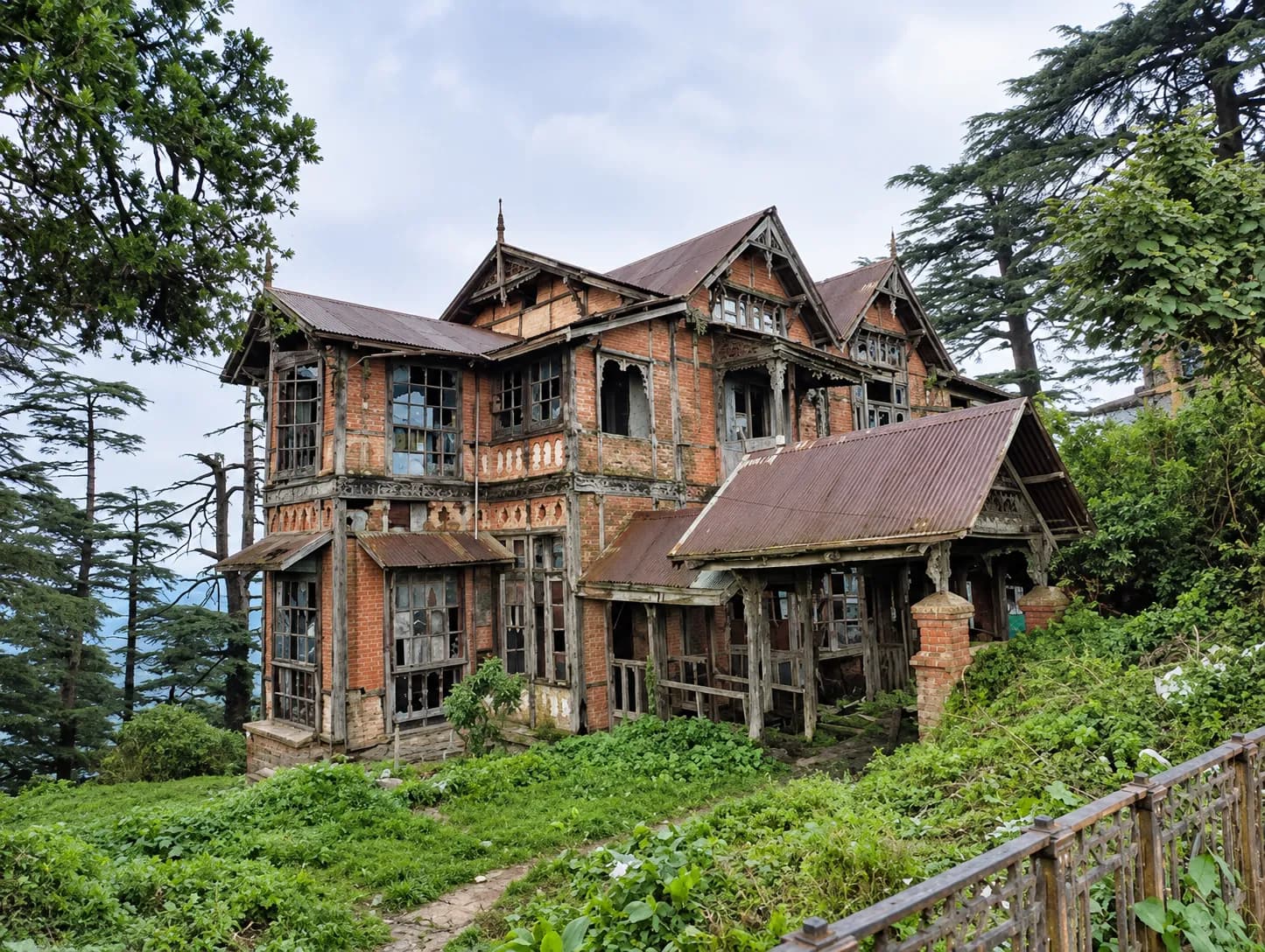
Mist rolling down a Himalayan ridge road at dusk. A railway tunnel the British abandoned halfway through. A fort the Archaeological Survey of India won't let you enter after sunset. A village that emptied out overnight two centuries ago and was never resettled. India doesn't need imported Halloween props — it has its own, built from genuine colonial-era tragedy, royal intrigue, and stories that have been retold at roadside dhabas for generations.
This guide covers 15 places across India with a reputation for being haunted — some with real, documented history behind them, others built almost entirely on local folklore. We've tried to be upfront about which is which throughout, rather than presenting every ghost story as established fact. None of these are "official" tourist attractions built around the paranormal — they're real forts, mines, mansions and monuments that happen to have picked up eerie reputations over the decades, which makes visiting them (where it's safe and permitted) as much a history lesson as a spooky one.
A quick honesty note before we start: we haven't personally verified every claim below, and neither has anyone else — that's the nature of ghost stories. Where a detail is documented history (a death, a court case, a fire, a construction record), we've said so. Where it's local legend or an unverified traveller account, we've said that too. Treat the paranormal claims as exactly that: claims, not proof.
Haunted Places in Uttarakhand
Mussoorie and the hills around Dehradun have more than their fair share of colonial-era mystery, partly because the British used this stretch of the Himalayan foothills so heavily as a hot-season retreat — which meant grand hotels, isolated bungalows, and more than a few unexplained deaths.
### 1. Lambi Dehar Mines, Mussoorie
The story: Lambi Dehar is a former limestone mine on Mussoorie's northern ridge, commonly nicknamed the "Mines of Death." Local lore holds that large numbers of workers died here, most accounts pointing to silica dust and gas exposure in unsafe working conditions, and that the site is now haunted by their spirits. You'll find claims online of worker death tolls in the tens of thousands — we couldn't find these backed by any official record, so treat specific numbers with real scepticism.
Verified history: The mines operated through most of the 20th century before being shut down (various sources put this anywhere from the mid-1990s onward) without any redevelopment. Industrial mining accidents and occupational lung disease among miners were a genuine, well-documented problem in India's limestone and mineral mining belt through this period, which is likely the real-world basis for the site's grim reputation — even if the specific "Mine of Death" death-toll claims circulating in travel blogs aren't independently sourced.
What you'll actually see: An abandoned, overgrown quarry and mine entrance, unmanaged and with no formal visitor infrastructure — no ticket counter, no marked trail, no safety railing.
Getting there: Roughly 8-10 km from Mussoorie's Library Chowk, reachable by local taxi; the final approach is on foot along an unpaved track.
Safety and access: This is not an officially managed tourist site. There's no lighting, no mobile network in patches, and the mine shafts themselves are unstable and should not be entered under any circumstances. Visit only in daylight, with a local guide who knows the terrain, and never alone.
Best time to visit: October to March, when Mussoorie's weather is clear and dry — avoid monsoon months when the unpaved approach gets slippery and landslide risk rises.
Trip type: A half-day add-on to a Mussoorie visit, not a standalone trip.
### 2. The Savoy Hotel, Mussoorie
The story: The Savoy is Mussoorie's grandest colonial-era hotel, and its reputation rests on one of the best-documented "haunted hotel" cases in India. In 1911, a wealthy spiritualist guest named Frances Garnett-Orme was found dead in her locked room, poisoned. Her companion, Eva Mountstephen, was tried for murder and acquitted in 1912 — the real killer was never identified. Garnett-Orme is said to still haunt the hotel's corridors and her former room.
The Agatha Christie connection: This is the detail that makes the Savoy genuinely notable beyond ghost-story circles: the unusual poisoning method in the case is widely reported to have reached Agatha Christie (via Rudyard Kipling and Arthur Conan Doyle) and influenced her first Hercule Poirot novel, *The Mysterious Affair at Styles*. The exact chain of who-told-whom isn't firmly nailed down in any single authoritative source, but the case itself — the death, the trial, the acquittal — is real, documented history, not folklore.
What you'll actually see: A working heritage hotel with preserved colonial architecture — if you're not a guest, the building and grounds are still worth viewing from outside, though interior access is naturally limited to paying guests.
Getting there: Central Mussoorie, an easy walk or short taxi ride from the Mall Road area.
Safety and access: No restrictions beyond normal hotel etiquette — this is a functioning, staffed property, not an abandoned site.
Best time to visit: Year-round, though Mussoorie's clearest views come October-June, outside peak monsoon.
Trip type: Easily combined with any Mussoorie weekend trip.
### 3. Lal Tibba & the Landour Colonial Trail
The story: Lal Tibba, Landour's highest viewpoint, isn't itself tied to a specific ghost story — but the colonial-era trail leading up to it, past the British Military Cemetery, old barracks and 19th-century churches like St. Paul's, is exactly the kind of quietly atmospheric, history-dense route that fuels Mussoorie's broader reputation for mystery. We're including it as a verified historical counterpoint to the more folklore-heavy entries on this list, not as a haunted site in its own right.
Verified history: Landour was established around 1825-1827 as a British sanatorium for soldiers recovering from illness, and the area's colonial cottages, cemetery and churches date to this period. Lal Tibba itself served as a British military vantage point given its commanding view.
What you'll actually see: Panoramic Himalayan views (on a clear day, reportedly as far as some of the higher peaks), colonial-era churches and cottages, and the atmospheric old cemetery.
Getting there: A walkable trail from Landour's Char Dukan area, about 20-30 minutes uphill from central Mussoorie.
Safety and access: No restrictions — this is a normal, popular walking trail with no entry barriers.
Best time to visit: Clear-sky months (October-June) for the viewpoint; avoid monsoon when cloud cover blocks the views entirely.
Trip type: A morning or afternoon walk, easily combined with the rest of a Mussoorie weekend.
Haunted Places in Himachal Pradesh
Shimla's hill-station history runs even deeper into the British Raj than Mussoorie's — it was the summer capital of British India — and that long colonial footprint shows up in its ghost stories just as much as in its architecture.
### 4. Tunnel No. 33, Barog
The story: The best-known haunted site on the Kalka-Shimla railway, a UNESCO World Heritage line. Popular legend holds that the tunnel's chief engineer, referred to in most accounts as Colonel Barog, dug the tunnel from both ends — and the two bores failed to meet. Publicly disgraced and reportedly fined a token sum by the British authorities, he's said to have taken his own life near the tunnel. His ghost is said to linger there still.
Verified history: The misaligned tunnel attempt and the engineer's resulting disgrace are consistently reported across multiple sources, including local heritage write-ups of the line — though exact details (the fine amount, the precise method of death) vary between retellings. The tunnel was eventually completed under chief engineer H.S. Harrington, with local tradition crediting a shepherd, Baba Bhalku, with helping locate the right path through the mountain — his contribution is honoured today at the Baba Bhalku Rail Museum in Shimla. The tunnel runs about 1,143 metres and the Kalka-Shimla line opened to passengers in 1903.
What you'll actually see: The tunnel itself (trains still run through it on the narrow-gauge line) and Barog station, a scenic, forested stop roughly midway between Kalka and Shimla.
Getting there: Barog is a regular stop on the Kalka-Shimla toy train; it's also reachable by road, just off NH5, roughly 100 km from Chandigarh.
Safety and access: The tunnel is an active railway tunnel — walking into it is unsafe and not permitted. The surrounding Barog station area and a popular "haunted tunnel hike" trail nearby are freely accessible.
Best time to visit: March-June and September-November for clear mountain views on the toy-train journey; the route is still scenic in winter but can see fog delays.
Trip type: A stop on a Shimla road trip, or a dedicated toy-train day trip from Kalka/Chandigarh.
### 5. Chudail Baudi, Shimla
The story: A roadside spot on the Shimla highway between Navbahar and Chota Shimla, where local drivers report seeing a woman in a white saree with long black hair covering her face, sometimes asking for a lift. We couldn't find any documented origin story for who this figure is supposed to be or when the legend began — it appears to be purely oral, roadside folklore rather than a story tied to a specific historical event.
Verified history: None that we could find — this is the one entry on our list that's essentially pure local legend with no documented backstory.
What you'll actually see: An ordinary stretch of hill road; there's no marker, structure or formal site to visit.
Getting there: Along the Shimla highway between Navbahar and Chota Shimla, passed through rather than specifically visited.
Safety and access: This is a live traffic road — there's nothing to "visit" here beyond driving through, so normal hill-road driving caution applies (narrow roads, blind curves) rather than any site-specific risk.
Best time to visit: Not applicable — it's a drive-through point, not a destination.
Trip type: Mentioned here for completeness as one of Shimla's most locally cited ghost stories, not as something to plan a stop around.
### 6. Charleville Mansion, Shimla
The story: A two-storey colonial villa built in 1913, now home to a hotel management institute. The building's haunted reputation dates to shortly after construction: a British couple who rented it, Victor Bayley and his wife, moved out after a few months following reports of a poltergeist in a sealed upstairs room. Ghost identities named in various retellings include a "Captain Charles Pratt" and a Victorian-era woman — the accounts aren't consistent on this point.
Verified history: The building's 1913 construction and the Bayleys' brief, unhappy tenancy are documented on its own Wikipedia entry, sourced mostly to period accounts and later retellings. After Indian independence in 1947, the mansion was sold and later repurposed; it now houses an institute of hotel management, which is a genuinely interesting footnote — a reputedly haunted colonial mansion now training the next generation of hospitality staff.
What you'll actually see: The exterior of a well-preserved colonial building — as an active educational institution, interior access for casual visitors is limited.
Getting there: Central Shimla, a short walk or taxi ride from the Mall Road area.
Safety and access: Respect that this is a functioning institute, not a public heritage site — view from outside rather than attempting to enter.
Best time to visit: Year-round; Shimla's peak season is April-June and December-February for snow.
Trip type: A stop on a broader Shimla sightseeing walk.
### 7. Jakhu Hill, Shimla
The story: This one is less "haunted" and more genuinely mythological. Jakhu Hill, Shimla's highest point, is topped by an ancient Hanuman temple. The Ramayana-linked legend holds that Hanuman rested here while searching for the Sanjivni herb to revive Lakshmana, and the temple marks the spot of his footprints. A second tradition credits a yaksha or a meditating sage with the temple's founding — accounts differ, and documented written history only goes back to an 1838 travelogue.
Verified history: The temple's existence is attested from the early 1800s, and a 108-foot Hanuman statue, now a Shimla landmark visible from much of the town, was unveiled here in 2010.
What you'll actually see: The temple complex, the giant Hanuman statue, sweeping views over Shimla, and a very large resident population of macaques considered sacred to the site — hold onto your belongings, as they're known to snatch food, bags and glasses.
Getting there: A steep but manageable uphill walk from central Shimla (roughly 2-2.5 km), or accessible by a ropeway from near The Ridge.
Safety and access: Open to the public during regular daylight temple hours; the main caution here is the monkeys, not anything supernatural.
Best time to visit: March-June and September-November for clear views; winter brings snow and a more dramatic but colder visit.
Trip type: A half-day Shimla sightseeing stop, easily combined with Mall Road and The Ridge.
Haunted Forts of Rajasthan
Rajasthan's forts are India's most famous "haunted" destinations internationally, and the reasons are a genuine mix of dramatic royal history and desert isolation.
### 8. Bhangarh Fort
The story: Widely called India's most haunted site. The best-known legend involves a sorcerer named Singhiya who fell in love with Bhangarh's princess, Ratnavati, and tried to win her through black magic — his plan backfired, killing him and cursing the entire town. Various visitor accounts describe disembodied voices and cold spots, though these are subjective, unverified claims rather than documented phenomena.
Verified history: Sources differ on the exact founding — either the latter half of the 16th century under Raja Bhagwant Das, or the 17th century under Raja Madho Singh. What's well documented is the ASI's current rule: a sign at the entrance, written in Hindi, explicitly prohibits entry before sunrise and after sunset, with legal consequences for violators. Local historians attribute this less to the supernatural and more to genuine safety — Bhangarh sits near the Sariska Tiger Reserve, and the unlit, rocky ruins see real wildlife movement after dark.
What you'll actually see: An extensive, atmospheric abandoned fort-town — temples, havelis, market streets and palace ruins across a sprawling site, once home to a reported 10,000 residents.
Getting there: About 85 km from Jaipur, roughly a 2-2.5 hour drive, often combined with a visit to Sariska.
Safety and access: Open during standard daylight hours (commonly cited as roughly 6 am-6 pm, though this is worth confirming locally before you go); entry after sunset is genuinely illegal, not just discouraged. Entry tickets are inexpensive.
Best time to visit: October to March, avoiding Rajasthan's harsh summer heat.
Trip type: A day trip from Jaipur, or a stop on a longer Rajasthan forts circuit.
### 9. Kuldhara Abandoned Village
The story: A Paliwal Brahmin village near Jaisalmer, abandoned overnight roughly two centuries ago, with every resident reportedly gone by morning and never returning. The most popular explanation is a curse: local legend says the village's minister, Salim Singh, desired a village chief's daughter, and when his men came to claim her, the entire community fled under cover of night and cursed the land as they left.
Verified history: Historians aren't actually certain why Kuldhara emptied out — the curse story is the most colourful explanation, but a declining water supply is equally, if not more, plausible: records show most of the village's wells had dried up by 1815, with only a handful of deep wells still functional by 1850. The Rajasthan government developed the site as a tourist attraction in the 2010s, partly leaning into its haunted reputation.
What you'll actually see: Rows of abandoned sandstone houses, a temple, and the ruins of what was clearly once a well-organised, prosperous settlement — genuinely atmospheric regardless of what you make of the ghost stories.
Getting there: About 18 km southwest of Jaisalmer, easily reached by taxi or as part of a desert sightseeing circuit.
Safety and access: Now a managed, ticketed heritage site with defined visiting hours — considerably more set up for tourism than Bhangarh or Lambi Dehar.
Best time to visit: October to March — Jaisalmer's desert summer is extreme, regularly exceeding 45°C.
Trip type: A half-day stop on a Jaisalmer trip.
### 10. Nahargarh Fort, Jaipur
The story: Built in 1734 by Sawai Jai Singh II as a retreat overlooking Jaipur, originally planned under the name Sudarshangarh. Local legend holds that construction was repeatedly destroyed overnight by the spirit of Nahar Singh Bhomia, a Rathore prince, until builders agreed to name the fort after him and build him a temple inside — both of which still stand today.
Verified history: The fort's construction, later 19th-century extensions under Sawai Ram Singh and Sawai Madho Singh, and its use as Jaipur State's official noon time-signal cannon site (until 1944) are all documented. Wikipedia and the Indian culture ministry both describe the Nahar Singh ghost story explicitly as "popular belief" or legend rather than fact, and note the fort was never actually attacked in its history.
What you'll actually see: A well-preserved, ticketed fort with sweeping views over Jaipur, the Nahar Singh temple, and (unlike Bhangarh or Kuldhara) a lively café and restaurant scene that makes it one of Jaipur's more pleasant sunset spots.
Getting there: About 15 km from central Jaipur, a straightforward taxi or auto ride.
Safety and access: Fully open to tourists during standard daytime hours — the most visitor-friendly entry on this list.
Best time to visit: October to March; the sunset views are a major draw year-round when skies are clear.
Trip type: A half-day Jaipur sightseeing stop.
Delhi NCR and Beyond
### 11. Agrasen ki Baoli, Delhi
The story: A striking 60-metre stepwell in central Delhi, long rumoured to be haunted — some versions claim its dark water "calls" people toward it, and that each suicide raises the water level. One detail worth noting for scale: the well is reportedly only around 5 feet deep today (it's kept dry by the ASI), which doesn't really support the more dramatic version of the story.
Verified history: Agrasen ki Baoli is a protected monument under the Archaeological Survey of India, governed by the Ancient Monuments and Archaeological Sites and Remains Act, 1958. Its construction is popularly credited to the legendary King Agrasen, though architectural historians date the existing structure to the 14th-century Delhi Sultanate period — the true builder and exact age remain genuinely uncertain. The site's popularity jumped significantly after it featured in the Bollywood film *PK*.
What you'll actually see: A dramatic 108-step stone stairwell descending between high walls — one of Delhi's most photogenic heritage sites, haunted reputation aside.
Getting there: Near Connaught Place and Hailey Road, central Delhi — easily reached by metro (Barakhamba Road station) or cab.
Safety and access: Open 9 am-5 pm daily, free entry. Visiting after dark isn't permitted, and isn't necessary — the site is fully visible and photogenic in daylight.
Best time to visit: October-March for pleasant Delhi weather; the site itself is accessible year-round.
Trip type: A standalone city stop, easily combined with other central Delhi sightseeing in a single afternoon.
### 12. Feroz Shah Kotla, Delhi
The story: Rather than ghosts, Feroz Shah Kotla — the 14th-century ruined fort of Sultan Feroz Shah Tughlaq — is associated with djinns. Every Thursday (considered an auspicious day for djinns in this tradition), visitors bring handwritten letters addressed to the djinns believed to inhabit the ruins, tucking or pinning them into niches in the walls, often alongside photocopies, a return address and even a photograph.
Verified history: This is genuinely one of the better-documented entries on this list — anthropologist Anand Vivek Taneja has written academically about the practice, tracing its modern form to a fakir known as Laddoo Shah who began living in the ruins in the 1970s, with the site becoming a significant pilgrimage spot from around 1977. The fort itself, including an Ashoka pillar relocated here by Feroz Shah Tughlaq, is ASI-protected. This isn't a story of a single haunted building — it's a real, ongoing, decades-old devotional practice that happens to centre on a reputedly supernatural belief.
What you'll actually see: Extensive 14th-century fort ruins, the relocated Ashoka pillar, and — especially on Thursdays — walls genuinely covered in handwritten letters and photocopied petitions.
Getting there: Near ITO, central Delhi, close to Delhi Gate; easily reached by metro or cab.
Safety and access: A standard ASI-ticketed site with normal daytime visiting hours — nothing unusual about access beyond any other protected monument.
Best time to visit: Thursdays specifically, if you want to see the letter-writing tradition in action; otherwise any day in the October-March cooler months.
Trip type: A standalone Delhi city stop, or combined with Agrasen ki Baoli for a half-day heritage walk.
### 13. Dumas Beach, Surat, Gujarat
The story: An Arabian Sea beach about 21-23 km southwest of Surat, known for its unusually dark sand. Local legend says the beach was once a Hindu cremation ground, and that the black colour comes from ashes — some tellings add that the area also served as a burial ground for those denied cremation rites, and that their spirits haunt the shore. Reported phenomena include whispers and disappearing visitors, though — as Dumas Beach's own Wikipedia entry notes — these reports remain unproven and are widely considered an urban legend.
Verified history: The more mundane, geology-based explanation is that the sand's dark colour comes from a high iron content, not human remains — a genuinely competing, non-supernatural explanation that most responsible write-ups note alongside the folklore.
What you'll actually see: A functioning public beach, popular for walks and street food stalls, that happens to have noticeably dark sand compared to most Indian beaches.
Getting there: About 21-23 km from central Surat, a straightforward taxi or auto ride.
Safety and access: A normal public beach with no special restrictions — the usual advice about not swimming alone after dark applies here as it would at any beach, for ordinary safety reasons rather than supernatural ones.
Best time to visit: November-February for pleasant coastal weather, avoiding Gujarat's intense summer heat and monsoon.
Trip type: A half-day Surat stop.
### 14. Shaniwar Wada, Pune
The story: The fortified palace of the Peshwa rulers of the Maratha Empire, where the 10th Peshwa, Narayanrao, was assassinated in 1773 on the orders of his own uncle and aunt, Raghunathrao and Anandibai, amid a succession dispute. Legend holds that on full-moon nights, his cries — "Kaka mala vachva" ("Uncle, save me") — can still be heard echoing through the ruins.
Verified history: The 1773 assassination is well-documented Maratha history, not folklore — this is one of the most solidly historical entries on the list. The palace's current ruined state is often linked to a devastating, still-unexplained fire in 1828, during the period when the British controlled the site; no definitive cause for the fire has ever been established. Locals and guides commonly advise against visiting alone or after dark, more as a matter of local custom than documented danger.
What you'll actually see: Fortified outer walls and gates (including the famous Delhi Darwaza) still stand, enclosing landscaped gardens where the palace's interior buildings once stood — most of the original wooden structure was lost to the 1828 fire.
Getting there: Central Pune, easily reached by auto, cab or the city's metro.
Safety and access: A ticketed, actively managed heritage site with standard daytime visiting hours, including an evening light-and-sound show recounting the Peshwa era.
Best time to visit: October-February for pleasant Pune weather.
Trip type: A standalone Pune heritage stop, often paired with the city's other historic sites.
### 15. Dow Hill, Kurseong
The story: A dense forest near Kurseong, about 30 km from Darjeeling in West Bengal, with a reputation built around sightings of a headless boy reportedly seen walking the road toward the forest office before vanishing, plus unexplained footsteps and voices reported at the adjacent, historic Victoria Boys' School during its winter closure.
Verified history: Victoria Boys' School (and its sister institution, originally co-educational Dow Hill School) dates to 1879, making it one of India's older educational institutions, still an active, government-run ICSE/ISC school today. Refreshingly, several locals and even the school's own management have openly pushed back on the haunted reputation in press interviews — one local told a Kolkata paper plainly that he didn't feel the area was haunted, while a school representative suggested the ghost stories might be, in their own words, "a marketing gimmick." It's a useful reminder that not everyone closest to these stories buys into them.
What you'll actually see: Dense, misty pine forest (genuinely atmospheric even without the ghost stories), colonial-era school buildings, and forest department trails.
Getting there: About 30 km from Darjeeling, roughly a 1-1.5 hour drive; Kurseong itself is a stop on the Darjeeling Himalayan Railway.
Safety and access: The forest trails are open to the public; the school itself is a functioning institution and not generally open for casual visits — view from outside.
Best time to visit: March-May and October-November for the clearest mountain views; monsoon brings heavy mist (atmospheric, but limits visibility).
Trip type: A stop on a wider Darjeeling-Kurseong hill trip, not a standalone destination.
Plan a Spooky Weekend Trip
A few honest, realistic ways to string these destinations into an actual trip — with durations and a rough sense of transport and budget. We've deliberately avoided quoting exact current hotel rates or entry fees here, since these change and we'd rather you confirm current numbers directly than rely on a figure that's gone stale.
### Mussoorie Mystery & Heritage Getaway (2-3 days)
Combine the Savoy Hotel, Lambi Dehar Mines and the Lal Tibba/Landour colonial trail with Mussoorie's regular sightseeing (Gun Hill, Kempty Falls, Camel's Back Road). Overnight Volvo buses run from Delhi to Mussoorie, and our own Rishikesh & Mussoorie package covers this broader Garhwal circuit if you'd rather not self-drive. Budget for 2 nights of hill-station accommodation plus a local taxi for the Lambi Dehar leg, since it's not reachable by regular transport.
### Shimla & Barog Spooky Road Trip (2-3 days)
Base yourself in Shimla for Chudail Baudi (drive-through), Charleville Mansion and Jakhu Hill, with a half-day or overnight detour to Barog for Tunnel No. 33 and the toy-train experience. Our Shimla, Kufri & Chail package covers the Shimla side of this trip; Barog is an easy add-on by road or toy train from there.
### Rajasthan Forts & Abandoned Village Trail (4-5 days)
A Jaipur-to-Jaisalmer arc covering Nahargarh Fort (Jaipur), Bhangarh Fort (en route or a day trip from Jaipur) and Kuldhara (near Jaisalmer). This genuinely needs more days than the hill-station trips given Rajasthan's distances — our Udaipur & Mount Abu package (from ₹7,800 per person) and Jaisalmer — The Golden City Experience (from ₹9,000 per person) cover parts of this region, though you'd need to arrange Bhangarh and Kuldhara as add-on excursions since they're not currently part of either package's fixed itinerary.
### Haunted Delhi Day Trip
Agrasen ki Baoli and Feroz Shah Kotla are both central and close enough to combine in a single afternoon by metro or cab — genuinely doable without an overnight stay, and a good option if you just want a taste of this list without committing a full weekend.
Travel Safety and Responsible Tourism
A few ground rules worth taking seriously, regardless of how seriously you take the ghost stories themselves:
- Never enter abandoned mines, sealed rooms or unstable structures. Lambi Dehar's mine shafts and any sealed-off sections at heritage sites are genuine structural hazards, independent of anything supernatural.
- Respect posted hours and closures. Bhangarh's sunset-to-sunrise ban is a legal rule, not a suggestion, and exists primarily for wildlife-safety reasons given its proximity to Sariska.
- Don't trespass on private or restricted property for a "paranormal experience." Several sites on this list (Charleville Mansion, Victoria Boys' School) are active institutions, not abandoned ruins open for exploration.
- Travel in groups, especially to remote or unmanaged sites like Lambi Dehar or the approach to Kuldhara, and let someone know your plan.
- Treat local staff and communities with respect. Several of the people closest to these stories — Dow Hill's own school management, Kuldhara locals — are on record being skeptical of the haunted reputation themselves; don't assume everyone wants to play along with ghost-hunting enthusiasm.
Frequently Asked Questions
What are the most haunted places in Uttarakhand? Lambi Dehar Mines and the Savoy Hotel, both near Mussoorie, are the two most commonly cited — the Savoy in particular has a well-documented real murder case behind its reputation.
Is Lambi Dehar Mines safe to visit? It's an unmanaged, abandoned mine site with no formal safety infrastructure. Daylight visits only, with a local guide, and never enter the mine shafts themselves — the structural risk is real regardless of the ghost stories.
Which are the most famous haunted places in Himachal Pradesh? Tunnel No. 33 at Barog and Shimla's Charleville Mansion are the best-known, alongside the Jakhu Hill temple (for its mythology rather than hauntings) and the roadside Chudail Baudi legend.
Can you visit haunted places near Delhi on a weekend? Yes — Agrasen ki Baoli and Feroz Shah Kotla are both central, easily combined in a single day, and don't require an overnight trip at all.
What is the story behind Tunnel No. 33 in Barog? Local legend says the tunnel's engineer, known as Colonel Barog, dug from both ends and the two bores failed to meet; publicly disgraced, he's said to have taken his own life near the site. The misalignment and his disgrace are consistently reported across sources, though some specific details vary by retelling.
Is Bhangarh Fort open to tourists? Yes, during standard daylight hours (commonly cited as roughly 6 am-6 pm, worth confirming locally) — entry between sunset and sunrise is explicitly prohibited by an ASI order, with real legal consequences, not just a scary story.
Which Indian destinations are suitable for Halloween travel in 2026? Any of the 15 covered here work as a spooky-themed trip, though we'd point first-timers toward Bhangarh Fort or Kuldhara (Rajasthan) and the Mussoorie/Shimla circuit for the strongest mix of genuine history and atmosphere.
How much does a spooky weekend trip from Delhi cost? It depends heavily on which circuit and how you travel — our real Rajasthan weekend packages start from ₹7,800-9,000 per person, while Mussoorie and Shimla trips are better quoted directly given seasonal pricing; we'd rather give you an accurate current number on request than a rough figure that's gone stale by the time you read this.
Final Thoughts
Whether or not you believe any of these stories, what ties this list together is real: colonial-era tragedy, royal intrigue, genuine historical uncertainty, and places that have outlasted the specific events that made them famous. That's arguably more interesting than a straightforward ghost story — and it's a good excuse to explore some genuinely offbeat corners of India you might otherwise skip.
If a Himalayan version of this trip appeals to you more than the desert one, get in touch and our team can help build an itinerary around Mussoorie, Shimla or the wider Uttarakhand and Himachal Pradesh circuits — real packages, honestly quoted, no invented ghost tours.