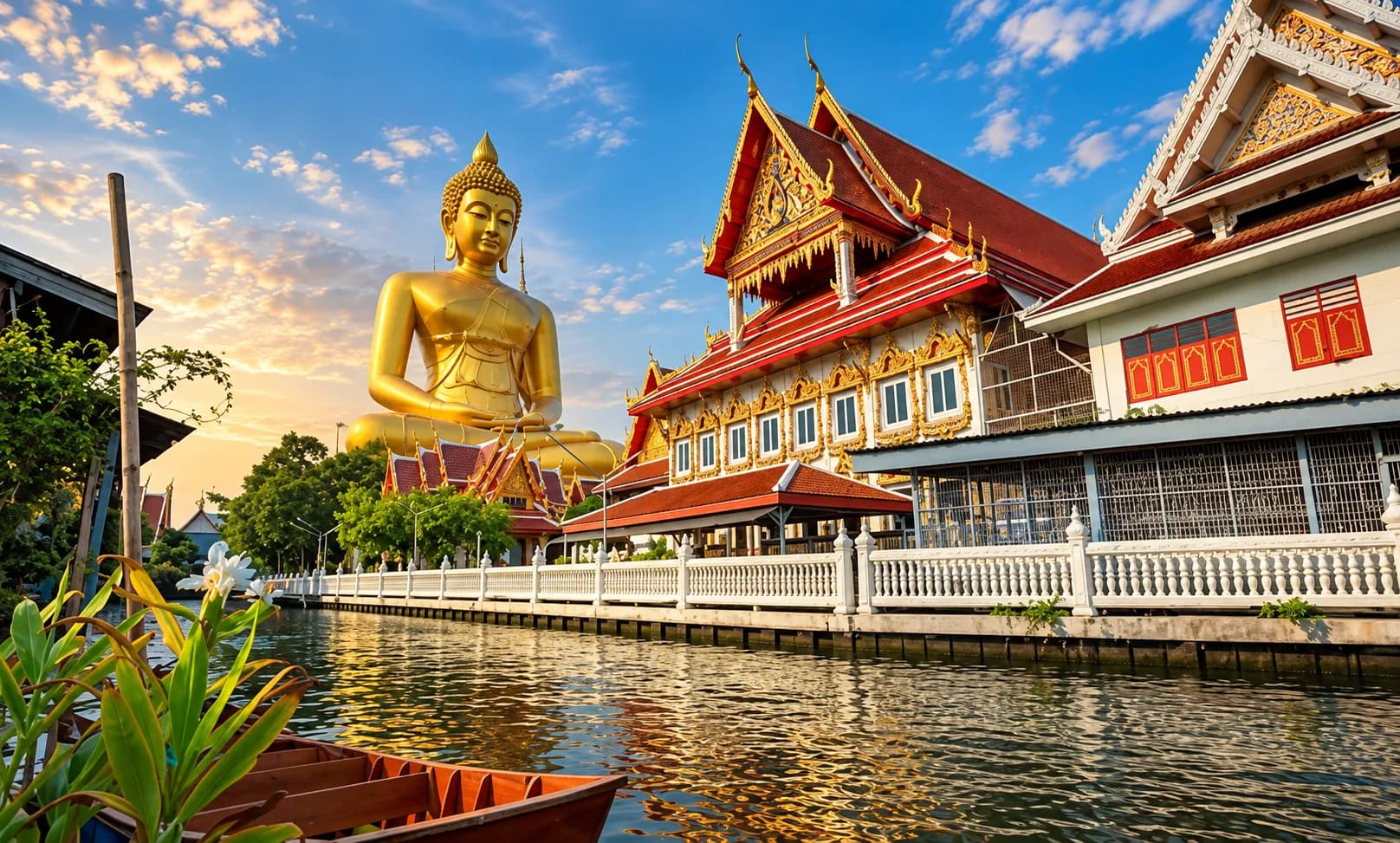
Ask ten Indian travellers why Thailand was their first international trip and you'll get ten different answers — the beaches, the temples, the food, the nightlife, the shopping, or simply that it's one of the easiest, most affordable countries to land in without overthinking the planning. That range of answers is really the point: Thailand doesn't force you to pick one kind of holiday. A single trip can genuinely cover a proper city break, island time, a mountain-town detour and a serious night out, without feeling like you're compromising on any one of them.
This guide is built around that flexibility — where to go, what each destination actually suits, a realistic 7-day itinerary (and an alternative for travellers who'd rather skip the islands), honest trip-cost ranges, and the current visa situation for Indian passport holders, which has genuinely changed more than once in the past couple of years. Whether you're planning a honeymoon, a group trip with friends, or a first international holiday with family, the goal here is to help you plan a Thailand tour package from India with realistic expectations, not a generic highlight reel.
Best Places to Visit in Thailand
### Bangkok
Thailand's capital is where most itineraries start, and it earns the role — the Grand Palace's gilded spires, Wat Arun's riverside silhouette (best seen at sunset from across the Chao Phraya), and Wat Pho's reclining Buddha give Bangkok a genuine temple-hopping day on their own. Beyond temples, Chatuchak Weekend Market's sheer scale and the Siam area's malls cover shopping at every budget, river taxis and dinner cruises give a different angle on the city, and street food here is a genuine attraction, not just a backdrop. Ideal duration: 2–3 days. Approximate budget: mid-range at roughly ₹3,500–5,500 per person per day including a 3–4 star hotel, meals and local transport. Best suited for: everyone — first-timers, couples, families and groups all get real value from a proper Bangkok stop. For Bangkok's full nightlife scene — rooftop bars, nightclubs and nightlife areas — see our dedicated Bangkok travel guide.
### Phuket
Thailand's largest and most developed island works mainly as a base rather than a single attraction — Patong Beach anchors the nightlife-heavy side, while Kata and Karon offer a calmer stretch a short drive away. From Phuket, day trips reach the Phi Phi Islands' turquoise lagoons and limestone cliffs, and James Bond Island's dramatic karsts in Phang Nga Bay, both by speedboat. Old Phuket Town's Sino-Portuguese shophouses and the Big Buddha viewpoint add a non-beach dimension if you want a break from the sand. Ideal duration: 3–4 days. Approximate budget: ₹4,000–7,000 per person per day, depending on resort category and how many day trips you add. Best suited for: couples and honeymooners (pool villas are widely available), and groups wanting an island base with genuine nightlife nearby.
### Krabi
Quieter and more scenery-led than Phuket, Krabi's signature is Railay Beach — accessible only by longtail boat, boxed in by sheer limestone cliffs that draw rock climbers as much as beachgoers. Ao Nang serves as the practical base, with its own beach and easy access to island-hopping trips covering the Phi Phi Islands, Koh Poda and the Four Islands circuit. Krabi trades Phuket's nightlife density for a genuinely more relaxed, nature-forward pace. Ideal duration: 2–3 days, often combined with Phuket rather than visited alone. Approximate budget: ₹3,500–6,000 per person per day — generally a touch more affordable than Phuket at a comparable hotel category. Best suited for: couples and nature-focused travellers who'd rather have cliffs and quiet than beach clubs.
### Pattaya
Roughly two hours from Bangkok by road, Pattaya is the practical choice when an internal flight isn't worth the time — the closest proper beach-and-entertainment destination to the capital. Walking Street carries its nightlife reputation, but Pattaya is genuinely more varied than that alone: Coral Island (Koh Larn) gives a calmer beach day trip by boat, the Sanctuary of Truth (an entirely wood-carved temple structure) is a legitimate cultural stop, and Nong Nooch Tropical Garden works well for families. Ideal duration: 2 days. Approximate budget: ₹3,000–5,000 per person per day — generally the most affordable beach stop on this list given lower transport and accommodation costs than the southern islands. Best suited for: travellers on a tighter timeline or budget, and groups wanting beach time without an extra flight.
### Chiang Mai
Thailand's north runs at a different pace entirely — Chiang Mai's old city, ringed by remnants of its original wall and moat, is genuinely walkable, with temples like Wat Phra Singh and Wat Chedi Luang spread through it rather than concentrated in one complex. Doi Suthep's hilltop temple gives a panoramic city view, the Night Bazaar and Sunday Walking Street lean toward handicrafts and textiles rather than mass retail, and ethical elephant sanctuaries (ones that don't offer riding, specifically) are a genuine draw for travellers who want an animal encounter done responsibly. Ideal duration: 2–3 days. Approximate budget: ₹3,000–5,000 per person per day — among the more affordable stops given lower accommodation costs than the islands. Best suited for: travellers who want a cultural, slower-paced contrast to the beach-and-city circuit, and anyone combining Thailand with genuine mountain scenery.
### Koh Samui
Thailand's Gulf-coast island runs on a different weather calendar from Phuket and Krabi (more on this below), which makes it a useful alternative when the Andaman coast is past its best window. Chaweng and Lamai are the main beach bases, Fisherman's Village in Bo Phut offers a quieter, boutique-shopping evening alternative, and the Big Buddha and Secret Buddha Garden give it a couple of genuine sightseeing stops beyond sand and resorts. Koh Samui generally skews toward a more relaxed, resort-centred holiday than Phuket's day-trip-heavy pace. Ideal duration: 3–4 days. Approximate budget: ₹4,500–8,000 per person per day — resort-driven pricing here tends to run a little higher than Phuket at a comparable category. Best suited for: couples and honeymooners specifically wanting a quieter, more resort-centred island stay, and travellers visiting outside the Andaman coast's best season.
Thinking about which of these actually fits your trip? Our team can help you narrow it down based on your dates, budget and who you're travelling with — get in touch and we'll talk through the realistic options.
Best Time to Visit Thailand
| Period | Months | What to Expect |
|---|
| Cool season | November–February | Generally the most comfortable, lower-humidity weather across most of the country — also the busiest and most expensive period, especially around December–January |
| Hot season | March–May | Genuinely high heat, particularly in Bangkok and Chiang Mai; still workable for beach destinations where sea breeze helps |
| Rainy season | June–October | Regular but usually short, heavy showers rather than all-day rain; sea conditions and island-hopping boat schedules can be affected |
One detail worth knowing before you book: Thailand's Andaman coast (Phuket, Krabi) and Gulf coast (Koh Samui) don't share the same rainfall calendar. The Andaman side's wetter months generally run May–October, while Koh Samui's wettest stretch typically falls later, from around September into December — so a month that's a poor choice for Phuket can still work reasonably well for Koh Samui, and vice versa. These are general seasonal patterns rather than a forecast; conditions vary year to year, and we're not going to promise sunshine for any specific date.
By activity:
- Island hopping: November–April generally gives the calmest seas and most reliable boat schedules on the Andaman coast; Koh Samui's equivalent window runs roughly December–April.
- Beach holidays: Cool season (November–February) for the most comfortable overall conditions; hot season works too if you don't mind higher daytime temperatures.
- Sightseeing (Bangkok, Chiang Mai): November–February for comfortable walking weather around temples and markets; March–May gets genuinely hot for a full day of city sightseeing.
- Shopping and city breaks: Largely weather-independent, since most of Bangkok's malls and markets are indoor or evening-focused — any season works reasonably well.
- Family trips: Cool season for the most manageable weather with children; avoid peak rainy months if island boat trips are part of the plan, since cancellations are a real possibility.
- Honeymoon holidays: November–April for the islands (Phuket, Krabi, Koh Samui) covers the better weather window for both coasts without needing to pick one over the other.
Thailand Trip Cost from India
The figures below are illustrative, per-person estimates for a 6-night/7-day trip — not live quotes. They assume travel from Delhi, a shoulder-season departure (outside the December–January peak), two travellers sharing a twin room, and a Bangkok-plus-one-island itinerary similar to the one below. Actual costs move with departure city, exact dates, hotel category and how far ahead you book, so treat these as planning ranges rather than a fixed number.
| Cost Category | Budget Traveller | Mid-Range Traveller | Premium Traveller |
|---|
| Return flights (Delhi) | ₹18,000–28,000, economy, advance booking | ₹25,000–38,000, economy, flexible dates | ₹45,000–75,000, premium economy/business |
| Accommodation (6 nights) | ₹10,000–16,000, budget 2–3 star | ₹18,000–30,000, 3–4 star | ₹40,000+, resort/pool villa |
| Meals & beverages | ₹5,000–8,000 | ₹9,000–14,000 | ₹16,000+ |
| Airport transfers & local transport | ₹2,500–4,000 | ₹4,500–7,000 | ₹9,000+, private transfers throughout |
| Island tours & sightseeing | ₹4,000–6,000 | ₹6,500–10,000 | ₹13,000+, private boat charters |
| Activities & entrance tickets | ₹2,000–3,500 | ₹3,500–6,000 | ₹8,000+ |
| Travel insurance & miscellaneous | ₹2,000–3,500 | ₹3,000–4,500 | ₹5,000+ |
| Approximate total per person | ₹43,500–69,000 | ₹69,500–1,09,500 | ₹1,36,000+ |
These are indicative ranges built from the assumptions above, not verified live prices — we haven't invented a specific flight fare, hotel rate or package price, and the lower end of the budget column is where a genuine Thailand trip under ₹50,000 becomes realistic, provided you book flights well ahead, keep the itinerary to Bangkok plus one closer beach destination (Pattaya rather than a southern island, for instance), and limit paid add-on activities. A few practical ways to manage your budget without cutting the experience short: book flights 2–3 months ahead rather than close to travel, choose a Bangkok-plus-Pattaya or Bangkok-plus-Phuket combination rather than trying to cover three regions, travel just outside the December–January peak when hotel rates ease, and decide which paid activities (island-hopping, a cooking class, a specific show) actually matter to you rather than adding everything on offer once you're there.
Share your travel dates, group size and budget with our team and we'll help put together a realistic cost estimate for your specific Thailand trip.
Perfect 7-Day Thailand Itinerary
Day 1: Arrive in Bangkok. Check in, and ease into the trip with an evening in the Old City or along the riverside — dinner with a view of Wat Arun lit up across the water is a good low-key start.
Day 2: Bangkok sightseeing. The Grand Palace and Wat Pho in the morning (before the heat and crowds build), Chatuchak Market or the Siam area in the afternoon for shopping, and a street-food-focused evening.
Day 3: Travel to Phuket. The Bangkok–Phuket flight runs roughly 1 hour 20–30 minutes, making this a genuinely practical transfer rather than a tiring one. Check in, and keep the evening relaxed — a beachfront dinner is enough for a travel day.
Day 4: Phuket beaches and viewpoints. Kata or Karon beach for a calmer stretch than Patong, the Big Buddha viewpoint, and Old Phuket Town's shophouse streets if you want a non-beach afternoon.
Day 5: Island excursion. A speedboat day trip to the Phi Phi Islands or James Bond Island — genuinely worth building a buffer day around, since island-hopping schedules do shift with sea conditions, particularly outside the November–April window.
Day 6: Krabi, more Phuket, or rest — your call. Here's the honest logistics: Krabi is roughly 1.75–3 hours from Phuket by road (taxi or private car), or around 1.5–2.5 hours by high-speed ferry including pier transfers — doable as a long day trip, but it does eat most of the day once you add transfer time both ways. If a relaxed finish matters more to you than ticking off Railay Beach, we'd suggest additional Phuket time or simple rest instead; if Krabi is genuinely a priority, treat this as a full-day excursion rather than a quick add-on, and know you'll have limited time actually at Railay itself.
Day 7: Departure. A relaxed beach morning, then transfer to Phuket International Airport for your flight home (direct Phuket–Delhi connections exist, though confirm current routes and timings when booking).
A genuinely important caveat: this itinerary covers Bangkok and Phuket properly but treats Krabi as optional rather than guaranteed, precisely because Bangkok-Phuket-Krabi in 7 days leaves limited slack for delays, weather or simply wanting to slow down. Travellers who want all three done without feeling rushed should look at 9–10 days instead — get in touch if you'd like help extending this into a less compressed version.
### Alternative: Bangkok & Pattaya (No Internal Flight)
For travellers who'd rather skip the islands and the domestic flight entirely, swap Days 3–7 above for: Day 3, road transfer to Pattaya (roughly 2 hours from Bangkok, no flight needed); Day 4, Pattaya beaches and a Coral Island (Koh Larn) boat trip; Day 5, the Sanctuary of Truth and Nong Nooch Tropical Garden, good for families specifically; Day 6, Pattaya's viewpoints and shopping, or an easy return to Bangkok for a final city evening; Day 7, departure from Bangkok. This version is generally the more budget-friendly and logistically simpler of the two, since it removes the domestic flight and island-hopping-weather variable entirely — a sensible choice for a first international trip or a tighter budget, at the cost of the islands' scenery.
Thailand Visa and Entry Requirements for Indian Travellers
Indian passport holders currently enter Thailand visa-free for short tourist stays under the country's visa-exemption arrangement, with no advance visa application or embassy visit required for tourism. The permitted stay length has genuinely changed more than once recently: it was 60 days through mid-September 2026, and entries from 15 September 2026 onward are granted 30 days specifically for tourism — a business trip still requires a separate visa arranged in advance. A one-time 30-day extension is available after arrival at a Thai immigration office for a fee.
Before arrival, Indian travellers need to complete the Thailand Digital Arrival Card (TDAC) online within 72 hours of entry — this is now a standard pre-arrival step alongside the usual passport and ticket checks. Practically, that means: a passport valid for at least six months from your arrival date, proof of onward or return travel, confirmed accommodation details, and (for the visa-exemption route specifically) evidence of sufficient funds for your stay, which some sources cite as a cash-on-hand figure — this detail isn't consistently confirmed across sources, so verify it directly before you travel rather than relying on a fixed number.
Given how often these rules have shifted, this isn't a substitute for checking Thailand's official immigration channels or the Royal Thai Embassy in New Delhi directly before you book — permitted stay length, arrival-card requirements and documentation can change again. If you'd rather not track this yourself, our team can confirm the current entry requirements when you enquire about your trip.
Thailand Travel Tips for Indians
| Topic | What to Know |
|---|
| Currency & payments | The Thai Baht (THB) is the local currency; cards and QR-code payments (PromptPay) are widely accepted in cities and resorts, though cash is still useful for markets, street food and smaller islands. |
| SIM & internet | Local tourist SIMs (AIS, True, dtac) are available at the airport on arrival; an international eSIM is a convenient alternative if your phone supports one. |
| Vegetarian & Indian food | Workable with some navigation — ask for "jay" (vegan/strict vegetarian) dishes to avoid fish sauce, a common hidden non-vegetarian ingredient; dedicated Indian restaurants are genuinely easy to find in Bangkok, Phuket and Pattaya, less so in Chiang Mai and the smaller islands. |
| Local transport & transfers | The BTS Skytrain and MRT cover central Bangkok efficiently; islands and smaller towns rely on taxis, tuk-tuks and songthaews (shared pickup trucks). |
| Ride-hailing apps | Grab is the main ride-hailing app across Thailand's major cities and tourist areas — generally more transparent on pricing than flagging a tuk-tuk or unmarked taxi. |
| Clothing & temple etiquette | Shoulders and knees covered for temple visits (sarongs are often available to rent/borrow at the entrance if needed); light, breathable clothing otherwise given the heat and humidity. |
| Weather & sun protection | High humidity year-round; sunscreen, a hat and hydration matter even on cloudy days, and afternoon showers in the rainy season are usually short rather than all-day. |
| Travel insurance | Worth having regardless of visa requirements — covers medical costs, trip delays and water-activity incidents, none of which are cheap to handle out of pocket abroad. |
| Island tours & sea safety | Use licensed tour operators for speedboat trips, snorkelling and diving, follow crew safety briefings and life-jacket instructions, and confirm current sea conditions before booking — operators do cancel or reroute trips in rough weather, and that's a safety call worth respecting rather than pushing against. |
| Local laws & behaviour | Thailand's laws around drugs remain strict for most substances despite regional cannabis-policy shifts — don't assume legality without checking current rules specifically; respect toward the monarchy and Buddhist religious sites is taken seriously and worth being mindful of. |
Thailand for Couples, Families and Friends
### Thailand for Couples
Phuket and Krabi's resorts, sunset-facing beaches and island-hopping day trips give couples a genuinely romantic core to build a trip around, and pool villas are available at a wide range of price points rather than only at the top end. Spa treatments are affordable enough to build into most days rather than treating as a one-off splurge, and a Bangkok-plus-one-island combination gives both a city chapter (rooftop dinners, a river cruise) and a beach chapter without needing a third region.
### Thailand for Families
Bangkok's malls and family-oriented attractions, Pattaya's Nong Nooch Tropical Garden and Coral Island day trips, and the generally manageable logistics (short flights, reliable Grab availability) make Thailand workable across a range of ages. The honest caveat: pace multi-region trips carefully with children in mind, since domestic flights, transfers and island-boat time add up faster than they look on paper — a Bangkok-plus-Pattaya trip (no internal flight) is often the simpler, lower-stress choice for families over a Bangkok-plus-island itinerary.
### Thailand for Groups of Friends
Shared villas in Phuket or Koh Samui, group island-hopping boats, and Thailand's well-developed group-tour infrastructure (shared vans, large resort blocks, private transport arrangeable for a whole group) make it genuinely practical for a friend-circle trip. Add in Bangkok and Phuket's nightlife, a wide range of adventure activities (diving, rock climbing at Railay, jungle trekking near Chiang Mai), and food that scales easily from street stalls to proper group dinners, and Thailand covers most of what a friends' trip typically wants from a single country.
Thailand Nightlife: Bangkok, Phuket and Pattaya
Thailand's after-dark scene varies meaningfully by city, and it's worth knowing the differences before you build an evening around a specific area.
Bangkok spans the widest range — rooftop bars with skyline views, the backpacker energy of Khao San Road, and more adult-oriented entertainment districts like Patpong and Soi Cowboy, all existing alongside family-friendly night markets rather than defining the whole city. You can genuinely pick the kind of evening you want here without it dominating your whole trip.
Phuket's nightlife concentrates heavily around Patong Beach, with a dense strip of bars and clubs; Kata and Karon, by contrast, stay considerably quieter in the evenings, which is worth knowing if nightlife isn't actually the point of your island stay.
Pattaya's Walking Street carries the city's loudest nightlife reputation, more overtly adult-entertainment-focused than Bangkok's broader mix, though Pattaya also has genuinely family-friendly evening options away from it — Nong Nooch's evening shows and the Sanctuary of Truth's night lighting among them.
Age restrictions, entry policies and specific venue operations vary and change — we're not naming individual clubs or bars here since operating status shifts often, and verifying any specific venue before you go is worth the five minutes it takes. Standard precautions apply across all three cities: use Grab or metered taxis rather than unmarked transport, keep an eye on your drink in busy venues, and drink at a pace that matches an unfamiliar climate and, often, a later body clock than you're used to at home.
Thailand vs Bali vs Vietnam
| Factor | Thailand | Bali | Vietnam |
|---|
| Estimated trip budget (7 days, per person) | ₹43,500–1,36,000+ | Broadly comparable, often slightly higher for villa-category stays | Often works out a little more affordable at a comparable hotel category |
| Beaches & islands | Strong — Phuket, Krabi, Koh Samui all genuinely different | Strong — Uluwatu, Nusa Dua and the Nusa Islands | Present but less the main draw — Phu Quoc and Da Nang are the closest equivalents |
| Cultural attractions | Strong — Bangkok's temples, Chiang Mai's old city | Strong — Ubud's temples and rice terraces | Strong — Hanoi's old quarter, Hoi An's lantern-lit streets |
| Nightlife | Strong and varied — Bangkok, Phuket, Pattaya each distinct | Present, concentrated in Seminyak/Canggu | Present, generally lower-key than Thailand's |
| Food | Thai cuisine, genuinely varied street food culture | Indonesian and a strong international/café scene | Vietnamese cuisine, widely regarded as excellent value |
| Suitability for couples | Strong | Strong — arguably Bali's single biggest strength | Good, more city-and-culture-led than beach-led |
| Suitability for families | Good, with careful pacing | Good, particularly in Nusa Dua's resort belt | Workable, though logistics are less tourist-streamlined than Thailand's |
| Ideal trip duration | 6–9 days | 6–8 days | 7–10 days, given the country's length |
None of these is a strictly better choice. Thailand suits travellers who want genuine variety — city, beach and mountains — within one well-connected country with established tourism infrastructure; Bali suits those who'd rather do one island thoroughly, with a strong villa and honeymoon culture; Vietnam suits travellers prioritising culture and value, with a different, less beach-centred holiday shape. See our Bali travel guide if you're weighing it specifically against a Thailand trip.
Frequently Asked Questions
What is the cost of a Thailand trip from India? For a 6-night/7-day trip from Delhi, illustrative estimates run roughly ₹43,500–69,000 per person for a budget trip, ₹69,500–1,09,500 for mid-range, and ₹1,36,000+ for a premium trip — see our full cost breakdown above for the assumptions behind these figures.
How many days are enough for Thailand? 7 days covers Bangkok plus one beach destination comfortably; 9–10 days allows Bangkok, Phuket and Krabi without feeling rushed, and a Bangkok-plus-Pattaya trip can work well in as few as 5–6 days.
What is the best month to visit Thailand? November to February generally offers the most comfortable weather across most of the country, though it's also the busiest and most expensive period — see our season-by-activity breakdown above for specifics.
Is Thailand suitable for first-time international travellers? Yes — visa-free entry for short tourist stays, direct flights from several Indian cities, widely available Indian food, and well-developed tourism infrastructure make it one of the more approachable first international trips.
What are the best places to visit in Thailand? Bangkok, Phuket, Krabi, Pattaya, Chiang Mai and Koh Samui cover the core list — see our destination-by-destination breakdown above for what each one specifically suits.
Is Thailand suitable for Indian families? Yes, with careful pacing — Bangkok and Pattaya's manageable logistics work well for families, while a multi-island itinerary needs more planning around transfer and flight times with children.
Can Thailand be explored within ₹50,000 per person? Yes, at the lower end of our budget estimate, provided you book flights well ahead, keep the itinerary to Bangkok plus a closer beach destination like Pattaya rather than a southern island, and limit paid add-on activities.
Is Thailand good for honeymooners? Yes — Phuket and Krabi's beach resorts, island-hopping, and Bangkok's rooftop dining scene make it a well-established honeymoon destination, with pool villas available across a range of budgets.
What are the visa requirements for Indian citizens? Indian passport holders currently enter visa-free for short tourist stays, with a 30-day permitted stay for entries from 15 September 2026 onward. Confirm current rules on Thailand's official immigration channels before you book, since this has changed more than once recently.
Is vegetarian food available in Thailand? Yes, with some navigation — asking for "jay" (vegan/strict vegetarian) dishes helps avoid fish sauce, a common hidden ingredient; dedicated Indian restaurants are easy to find in Bangkok, Phuket and Pattaya specifically.
Which is better for a first trip: Phuket or Krabi? Phuket, generally — it has more developed infrastructure, a wider range of hotels and day-trip options, and better flight connectivity; Krabi suits a second Thailand trip or travellers who specifically want a quieter, more scenery-led pace from day one.
Is Bangkok worth visiting on a beach holiday? Yes — pairing 2–3 days in Bangkok with a beach destination gives the trip genuine range (temples, markets and food, followed by islands or coastline), and it's a more complete first Thailand trip than skipping the capital entirely.
Plan Your Thailand Trip with Shubh Mangal Yatra
We arrange customised Thailand itineraries through our travel network rather than a single fixed package — built around which cities you want to combine, your travel dates, group size and budget. Whether that's Bangkok and Phuket for a couple's honeymoon, Bangkok and Pattaya for a family on a tighter budget, or a longer Bangkok-Phuket-Krabi circuit for a group of friends, we can help shape it. For more detail on getting around, food, shopping and day-to-day logistics once you're there, see our companion Thailand travel guide.
Share your travel dates, number of travellers and preferred budget with our team, and we'll share suitable hotel options and a personalised itinerary and quotation. Visit our Thailand trip page to enquire, call or WhatsApp us at +91 95990 67086, or talk to our travel team through our enquiry form.