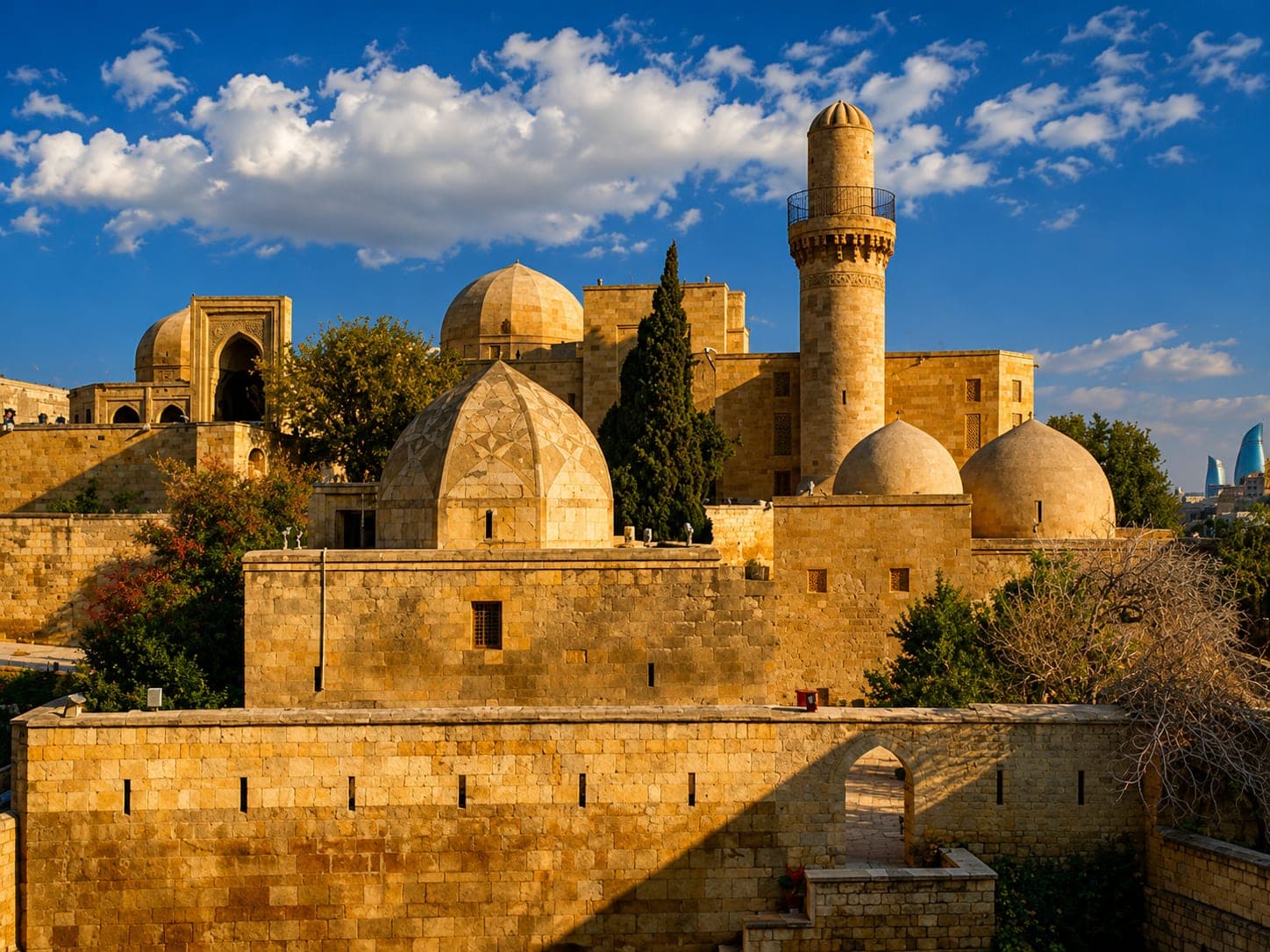
Baku sits at an odd crossing point for Indian travellers — close enough for a direct five-hour flight, with a visa process simple enough to sort in a few days, yet the city itself looks like nowhere else on a typical short-haul list: a 12th-century walled Old City a ten-minute walk from three glass towers shaped like flames, with the Caspian Sea along one edge of it all.
That contrast is a big part of why Azerbaijan's capital has become a genuine alternative to the usual Dubai-or-Bangkok short international trip — direct flights, a straightforward e-visa, and a city compact enough to see properly in four or five days without feeling rushed. This guide covers what actually matters for planning that trip: what to see, how many days to budget, the visa process, realistic costs, and how Baku works as a base for day trips into the rest of Azerbaijan. At Shubh Mangal Yatra we run a dedicated Baku, Gobustan and Gabala circuit from Delhi, referenced where relevant through this guide, but everything here stands on its own for planning the trip yourself too.
Where Is Baku Located?
Baku is the capital of Azerbaijan, a country in the South Caucasus — the region bridging Eastern Europe and Western Asia, bordered by Russia, Georgia, Armenia and Iran. The city sits on the Absheron Peninsula, jutting into the Caspian Sea, the world's largest inland body of water. That coastal position is part of why Baku's climate and skyline both feel distinct from Azerbaijan's mountainous interior.
Baku is also below sea level — one of the lowest-lying national capitals in the world — which is part of why the city is so notoriously windy. Flights land at Baku's Heydar Aliyev International Airport, and most onward Azerbaijan travel (Gabala, Sheki, Quba) starts from the capital.
Why Visit Baku?
Three things make Baku stand out on a short-haul international itinerary: the contrast between old and new, the Caspian waterfront, and genuine value for a non-mainstream destination.
The contrast is the headline. Icherisheher, Baku's walled Old City, is a UNESCO World Heritage Site with 12th-century architecture, narrow stone lanes and centuries-old monuments. A ten-to-fifteen-minute walk away stand the Flame Towers and the Heydar Aliyev Center — among the more distinctive pieces of contemporary architecture built anywhere in the last two decades. Few cities put medieval and ultra-modern this close together.
Baku Boulevard runs along the Caspian Sea for several kilometres, giving the city an evening promenade culture — families, couples and groups walking, eating and watching the Flame Towers light up after dark. Add genuinely good food (Azerbaijani cuisine draws on Turkish, Persian and Central Asian influences), a low-key but real nightlife scene around Nizami Street, and museums covering everything from carpets to miniature books, and Baku works for city-break travellers, couples, families and first-time international travellers alike.
For Indian travellers specifically, the practical case is strong: a direct flight under six hours, an e-visa process that doesn't need an embassy visit, and packages (including ours) that already build in Indian-restaurant meals and visa handling — removing two of the bigger friction points of a first international trip. If you're comparing Baku against other short-haul options, see our full range of international tour packages for context.
Best Time to Visit Baku
| Season | Months | What to Expect | Best For |
|---|
| Spring | March–May | Mild, roughly 12–22°C, greenery returning, fewer crowds | First-time visitors, photography, comfortable walking |
| Summer | June–August | Warm to hot, roughly 25–35°C, long daylight hours, peak season | Caspian waterfront evenings, Gabala as a cooler day trip |
| Autumn | September–November | Mild, roughly 10–20°C, comfortable sightseeing weather | Couples, first-time visitors, Old City walking |
| Winter | December–February | Cold, often below 10°C, Baku's wind at its sharpest | Budget travellers, city sightseeing without crowds |
April–June and September–October are generally the strongest windows — mild enough for extended Old City walking and day trips, without summer's heat or winter's wind chill. Summer stays the busiest season since it lines up with Indian school holidays, so expect higher hotel rates and more visitors at the main sights. Winter works for city-only sightseeing (museums, indoor attractions, the Old City) but makes day trips to Gabala or Gobustan less comfortable, and Baku's wind — strong enough to have earned the city its "City of Winds" nickname — is most noticeable this time of year.
These are general seasonal patterns rather than a forecast; check current conditions closer to your travel dates, since any given year can run warmer, colder or windier than the typical range.
Baku Weather and Temperature
Baku's climate is semi-arid with a strong maritime influence from the Caspian Sea, which moderates temperature swings compared to Azerbaijan's mountainous interior but doesn't do much for the wind. Summers are dry and warm, winters are cool rather than freezing, and the city sees relatively little rainfall across the year compared to much of India. Pack for wind in every season — even a mild spring or autumn day in Baku can turn blustery along the Boulevard or at the Highland Park viewpoint.
Places to Visit in Baku
| Attraction | What It Is | Time Needed | Best Time to Visit |
|---|
| Icherisheher (Old City) | Walled 12th-century old town, UNESCO World Heritage Site | Half a day | Morning or late afternoon |
| Maiden Tower | 12th-century stone tower within the Old City | 30–45 minutes | Any time; combine with the Old City walk |
| Palace of the Shirvanshahs | 15th-century royal palace complex | 45–60 minutes | Morning, before midday heat in summer |
| Flame Towers | Three flame-shaped skyscrapers, Baku's modern landmark | 30–45 minutes at the viewpoint | Sunset and after dark |
| Heydar Aliyev Center | Zaha Hadid-designed cultural centre | 1–2 hours | Daytime for the architecture; exhibitions vary |
| Baku Boulevard | Caspian Sea waterfront promenade | 1–3 hours | Evening |
| Highland Park | Hilltop park and viewpoint over the city and Caspian | 30–60 minutes | Late afternoon into sunset |
| Martyrs' Lane | Memorial site adjoining Highland Park | 20–30 minutes | Combine with Highland Park |
| Nizami Street / Fountain Square | Pedestrian shopping street and square | 1–2 hours | Evening |
| Carpet Museum | Museum dedicated to Azerbaijani carpet-weaving | 45–60 minutes | Daytime |
| Little Venice | Small artificial canal attraction near the Boulevard | 20–30 minutes | Evening, with the Boulevard |
| Baku Ferris Wheel | Observation wheel on the Boulevard | 20–30 minutes | Evening, for city and Caspian views |
This covers the realistic core list — enough to fill three to four focused days without resorting to attractions that don't earn the detour. The sections below go deeper on the ones worth planning around specifically.
Baku Old City (Icherisheher)
Icherisheher is Baku's walled old town and its UNESCO World Heritage Site, with origins dating to the 12th century. It sits directly against the modern city centre, which is part of what makes the contrast so striking — stone walls and narrow lanes on one side, glass towers visible over the ramparts on the other.
Two sights anchor a visit. The Maiden Tower (Qız Qalası) is a cylindrical stone tower whose original purpose is still debated by historians, and climbing it gives a rooftop view over the Old City and out toward the Caspian. The Palace of the Shirvanshahs, a 15th-century royal residence, is the largest surviving monument of the Shirvanshah dynasty and includes a mausoleum, mosque and bathhouse within its complex.
Beyond the two headline sights, Icherisheher rewards unhurried walking — caravanserai buildings converted into cafes and carpet shops, the small Miniature Book Museum, and stone lanes that look different in morning light versus late afternoon. Budget half a day to do it properly; a rushed version can technically be done in two hours, but that undersells what's there. Shopping inside the Old City leans toward carpets, souvenirs and handicrafts aimed at visitors — reasonable for gifts, though prices at the smaller stalls assume some bargaining.
Heydar Aliyev Center
Designed by Zaha Hadid and opened in 2012, the Heydar Aliyev Center is Baku's best-known piece of contemporary architecture — a flowing, white, wave-like structure with no sharp edges, built to deliberately contrast with the rigid Soviet-era architecture still visible elsewhere in the city. It won the London Design Museum's Design of the Year award in 2014.
Inside, the center hosts rotating exhibitions, a permanent collection and event spaces; what's on display changes over time, so check current exhibition details closer to your visit rather than assuming a specific collection will be showing. For most visitors, the building itself — inside and out — is the main draw, and it photographs differently depending on the light, with the exterior plaza also worth the walk. Budget one to two hours, more if a current exhibition interests you.
Flame Towers and Highland Park
The Flame Towers are three skyscrapers — the tallest around 182 metres — built to resemble flames, a deliberate reference to Azerbaijan's historic association with fire (from natural gas seeps that gave rise to local fire-worship traditions, covered further in the day-trips section below). At night, LED façades turn the towers into a synchronised light display visible across much of the city, and this is the version worth planning around — daytime Flame Towers are a landmark; after-dark Flame Towers are a spectacle.
The best vantage points are from Baku Boulevard across the water, or from Highland Park, a hillside park directly behind the towers that doubles as the city's best overall viewpoint — Old City, modern skyline and Caspian Sea in one frame. Highland Park also adjoins Martyrs' Lane, a memorial and eternal flame dedicated to those who died in the conflicts of the early 1990s and 2020 — a quieter, reflective stop rather than a sightseeing highlight, worth visiting out of respect rather than skipping entirely. Time your Highland Park visit for an hour before sunset to catch both the daylight view and the Flame Towers switching on.
Baku Boulevard and the Caspian Sea
Baku Boulevard (officially the Baku National Park, but universally called the Boulevard) runs roughly 3.5 kilometres along the Caspian waterfront and functions as the city's evening living room — families and couples walking, restaurants and cafes along the water, and a steady stream of joggers and cyclists earlier in the day.
Within the Boulevard stretch, Little Venice offers a small network of artificial canals with gondola-style boat rides, and the Baku Ferris Wheel gives an elevated view back toward the city and out over the Caspian — both minor attractions individually, but worth folding into an evening Boulevard walk rather than visiting as standalone trips. The Caspian itself isn't a swimming-beach destination at this stretch of coastline; treat it as a scenic waterfront rather than a beach holiday. Evenings here work well for families (wide, flat, stroller-friendly paths), couples (restaurants with Caspian views, the Flame Towers lit up across the water), and groups looking for a low-effort, high-payoff few hours after a day of sightseeing.
Things to Do in Baku
Beyond the named attractions, Baku rewards a few activity-based approaches: walking the Old City without a fixed checklist, an evening built entirely around the Boulevard and Flame Towers, an afternoon in the Fountain Square and Nizami Street shopping district, and at least one proper sit-down meal built around Azerbaijani cuisine rather than international chains. Photography-focused travellers should prioritise the Flame Towers at night, Highland Park at sunset, and the Old City in early morning light before crowds build. The sections below cover nightlife, shopping and food in more depth.
Baku Nightlife
Baku's nightlife centres on Nizami Street and the area around Fountain Square, with a mix of bars, lounges and a handful of clubs — more low-key than Dubai or Istanbul's party scenes, and better suited to an evening of good food and drinks than an all-night club circuit. The Boulevard area also has restaurant-bars with Caspian views that work well for a relaxed evening.
A few practical and cultural notes: Azerbaijan is a secular, majority-Muslim country where alcohol is legal and widely available in tourist areas, but dress and behaviour expectations are more conservative than a European nightlife district — casual smart dress works fine, and overt rowdiness isn't well received. Walking back to central hotels late at night is generally considered safe in the main tourist areas, though the usual city precautions (sticking to well-lit streets, keeping valuables secure, using a licensed taxi rather than hailing an unmarked car) apply here as anywhere.
Baku Shopping
Nizami Street (locally called "Torgovaya") is Baku's main pedestrian shopping street, running into Fountain Square — a mix of international fashion brands, local boutiques, cafes and street performers in the evening. For souvenirs and handicrafts specifically, the Old City's shops around the Maiden Tower and the Palace are the better bet: carpets, ceramics, tea sets and saffron are the most-bought items, with carpets in particular a genuine Azerbaijani craft tradition carrying UNESCO Intangible Cultural Heritage recognition — buy from an established shop rather than a street vendor if provenance matters to you. For modern shopping-mall browsing, central Baku has several large malls with the usual international retail mix — more about air-conditioned downtime on a hot day than a destination in themselves.
Azerbaijani Food in Baku
Azerbaijani cuisine draws on Turkish, Persian, Central Asian and Caucasian influences, built around rice, grilled meats, fresh herbs and a genuine tea culture.
| Dish | What It Is |
|---|
| Plov | Saffron rice, typically layered with meat, dried fruit or herbs — Azerbaijan's signature dish |
| Dolma | Grape leaves or vegetables stuffed with rice and minced meat |
| Kebabs (kabab) | Grilled meat skewers, a staple across most sit-down restaurants |
| Qutab | Thin stuffed flatbread, often with greens, pumpkin or meat fillings |
| Piti | A slow-cooked lamb and chickpea stew, served in individual clay pots |
| Dushbara | Small dumplings in broth, similar in concept to momos or ravioli |
| Baklava (Azerbaijani-style) | Layered pastry with nuts and syrup, a standard dessert and tea-time sweet |
| Azerbaijani tea (chay) | Served throughout the day in pear-shaped glasses (armudu), usually with jam rather than milk |
Vegetarian travellers have workable options — qutab with greens or pumpkin filling, dolma made with vegetables and rice, fresh salads, and bread-and-cheese spreads are all genuinely vegetarian, though menus skew meat-heavy overall and vegetarian labelling isn't as explicit as in India. For travellers who'd rather not navigate this by trial and error, our Baku package builds in meals at Indian restaurants specifically, alongside the local-cuisine experiences worth having at least once.
Baku for Indian Travellers
A few practical points for planning this trip from India: Indian cuisine is available in Baku, which matters if you want a familiar meal between days of Azerbaijani food. English is reasonably common in hotels, major attractions and tourist-facing restaurants, though Azerbaijani and Russian are the everyday languages — simple translation apps cover most gaps. Card payments are widely accepted in the capital, and connectivity (mobile data, hotel Wi-Fi) is generally reliable in central Baku, less so in rural day-trip areas like Gobustan or deep into the Gabala countryside.
Culturally, Azerbaijan is more liberal than its "majority-Muslim country" label might suggest to a first-time visitor — Western dress is normal in central Baku, alcohol is served openly, and public behaviour norms sit closer to Turkey than to more conservative parts of the Gulf. That said, modest dress is appropriate when entering mosques and at memorial sites like Martyrs' Lane. For families and groups specifically, Baku's flat, walkable city centre and metro system make logistics easier than many international destinations, and the compact core (Old City, Boulevard, Flame Towers, Fountain Square) means less time lost to transfers than a geographically spread-out itinerary.
Azerbaijan Visa for Indians (e-Visa)
Indian passport holders need a visa to enter Azerbaijan, and the standard route is the ASAN e-Visa — an online electronic visa that doesn't require an embassy or consulate visit. Applications are submitted through the official portal, evisa.gov.az, which is Azerbaijan's government e-visa platform; treat this as the only authoritative source for current fees, processing times and requirements.
Based on currently published guidance, the e-visa for Indian citizens is typically issued as a single-entry tourist visa, valid for 90 days from the date of issue, permitting a stay of up to 30 days per visit. Standard processing is commonly reported at around 3 business days, with an urgent-processing option (a higher fee) available for faster turnaround. Typical documentation includes a passport with a few months' validity beyond your travel dates, a passport-style photograph, and basic travel details (dates, accommodation).
Fees and processing times change, and this article isn't a substitute for checking evisa.gov.az directly before you apply. Apply one to two weeks ahead of travel as a sensible buffer rather than relying on urgent processing as a default plan. If you'd rather not manage the application yourself, our team can walk you through the current process and documentation when you enquire about a Baku package — visa handling is already built into our standard Azerbaijan itinerary.
How to Reach Baku from India
Azerbaijan Airlines operates direct flights between India and Baku, with service from both Delhi and Mumbai, taking roughly five to five-and-a-half hours — among the more convenient international options for a first-time long-haul-adjacent trip, since it avoids a layover entirely from those two cities.
| Departure City | Route Type | Approx. Flight Time |
|---|
| Delhi | Direct | ~5 hours |
| Mumbai | Direct | ~5–5.5 hours |
| Bangalore | Connecting, via Delhi, Mumbai or a Gulf hub | 8+ hours with layover |
| Hyderabad | Connecting, via Delhi, Mumbai or a Gulf hub | 8+ hours with layover |
Airlines add, change and suspend routes regularly, so treat this as a general picture rather than a booking guarantee — confirm current direct-flight availability and schedules when you're ready to book, since frequencies can shift seasonally.
Baku Airport
Flights land at Heydar Aliyev International Airport (GYD), about 20 kilometres northeast of central Baku. Licensed airport taxis and ride-hailing options cover the transfer into the city, typically taking 30–40 minutes depending on traffic; most hotels and tour operators can also arrange a pre-booked transfer, the more predictable option after an international flight.
Getting Around Baku
| Option | Best For | Notes |
|---|
| Walking | Old City, Boulevard, Fountain Square | Central Baku's main sights are genuinely walkable |
| Metro | Longer city-centre hops | Affordable and efficient; signage includes English in parts |
| Taxi / ride-hailing | Airport transfers, evening trips, day-trip connections | Use licensed taxis or hotel-arranged cars over street hails |
| Private transfer | Day trips (Gobustan, Gabala), groups, families | Most comfortable for Absheron and Gabala/Sheki routes |
| Buses | Budget travel within the city | Less tourist-friendly without local-language signage |
For a short visit focused on the city core, walking plus the occasional taxi covers almost everything. Day trips outside Baku (Gobustan, Ateshgah, Yanar Dag, Gabala) are more practical with a private transfer or an organised tour than public transport, given the distances and limited English-language signage once you're outside the capital.
Baku Itinerary: 2 to 7 Days
2 Days / 1 Night
Day 1: Arrive, Old City walk — Maiden Tower, Palace of the Shirvanshahs — evening at Baku Boulevard and the Flame Towers after dark. Day 2: Heydar Aliyev Center, Fountain Square and Nizami Street, departure.
3 Days / 2 Nights
Day 1: Arrive, Old City. Day 2: Heydar Aliyev Center, Highland Park and Martyrs' Lane at sunset, Boulevard evening. Day 3: Gobustan half-day — rock carvings and mud volcanoes — departure.
4 Days / 3 Nights
Day 1: Arrive, Old City. Day 2: Heydar Aliyev Center, Fountain Square, Flame Towers at night. Day 3: full Absheron day — Gobustan, Ateshgah Fire Temple and Yanar Dag. Day 4: Boulevard, Carpet Museum, departure.
5 Days / 4 Nights
Day 1: Arrive, Old City. Day 2: Heydar Aliyev Center, Highland Park, Boulevard evening. Day 3: Absheron day trip — Gobustan, Ateshgah, Yanar Dag. Day 4: Gabala day trip — Tufandag Mountain Resort, Nohur Lake. Day 5: Fountain Square, free time, departure.
6 Days / 5 Nights
Day 1: Arrive, Old City. Day 2: Heydar Aliyev Center, Highland Park, Boulevard. Day 3: Absheron day trip. Day 4–5: Gabala and Sheki overnight — Tufandag Resort, Sheki Khan's Palace, old town. Day 6: Return to Baku, departure.
7 Days / 6 Nights
Day 1: Arrive, Old City. Day 2: Heydar Aliyev Center, Highland Park, Boulevard. Day 3: Absheron day trip. Day 4–5: Gabala and Sheki overnight. Day 6: Free day in Baku — Carpet Museum, Nizami Street shopping, or a repeat visit to the Old City's cafes. Day 7: Departure.
Durations beyond 4 days are where a Gabala extension genuinely earns its place; shorter trips are better spent going deeper on Baku itself than rushing a mountain detour in and out.
Baku Day Trips
| Day Trip | Distance from Baku | Why Visit | Duration |
|---|
| Gobustan National Park | ~1 hour | Prehistoric rock carvings (petroglyphs), UNESCO World Heritage Site | Half day |
| Gobustan mud volcanoes | Near Gobustan park | Unusual geological phenomenon — bubbling mud rather than lava | Add-on to the Gobustan visit |
| Ateshgah Fire Temple | ~30 minutes | Historic fire-worship temple linked to the region's natural gas seeps | 45–60 minutes |
| Yanar Dag (Burning Mountain) | ~45 minutes | A hillside with a continuously burning natural gas vent | 30–45 minutes |
| Absheron Peninsula (combined) | 30 minutes–1 hour | Gobustan, Ateshgah and Yanar Dag combined into one day | Full day |
Gobustan, Ateshgah and Yanar Dag sit close enough to each other and to Baku that most visitors combine all three into a single full-day trip rather than three separate outings — this is how our own Baku itinerary structures it. Summer works fine for all three, though Gobustan's open rock-carving site has little shade; carry water and sun protection if visiting midday.
Combining Baku with Gabala and Sheki
Gabala sits roughly 3–4 hours from Baku by road, in Azerbaijan's forested foothills — a genuinely different landscape from the capital, with the Tufandag Mountain Resort (cable car access), Nohur Lake, and noticeably cooler temperatures that make it a popular summer escape from Baku's heat. Given the round-trip drive time, Gabala works better as an overnight addition than a single rushed day trip, though a long day trip is possible if your schedule is tight.
Sheki, a further 1.5–2 hours past Gabala, adds the Sheki Khan's Palace and a well-preserved old town with Silk Road-era history and caravanserai architecture. For travellers with 5+ days total, Gabala and Sheki together as a 2-day, 1-night extension is the standard add-on, giving the trip a mountains-and-old-town contrast to Baku's city-and-coast character. For trips under 5 days, we'd generally recommend skipping Sheki and keeping Gabala as, at most, a long day trip — Baku itself has enough to fill a shorter visit without a rushed overnight detour.
Azerbaijan Beyond Baku
| Destination | Known For | Realistic With Baku? |
|---|
| Gabala | Mountain resort, cable car, cooler climate | Yes — day trip or overnight on 5+ day trips |
| Sheki | Khan's Palace, old town, Silk Road history | Yes, paired with Gabala, on 6+ day trips |
| Quba | Apple orchards, mountain scenery, old quarters | Possible for longer, more exploratory trips |
| Shahdag | Ski resort (winter), mountain scenery | Winter-specific, not a standard add-on |
| Absheron Peninsula | Gobustan, Ateshgah, Yanar Dag | Yes — standard day trip from Baku |
Azerbaijan has more to offer than this guide covers in depth, but for most first-time Indian travellers on a 4–7 day trip, Baku plus an Absheron day trip (and Gabala/Sheki if time allows) is the realistic, well-tested combination rather than an ambitious multi-region circuit.
Baku Trip Cost
| Cost Category | Budget Traveller | Comfortable Traveller | Premium/Luxury Traveller |
|---|
| Flights (round trip, Delhi/Mumbai) | Economy, advance booking | Economy, flexible dates | Premium economy or business |
| Visa | e-Visa, standard processing | e-Visa, standard processing | e-Visa, urgent if needed |
| Hotels | Budget 2–3 star | 3–4 star | 5 star or boutique luxury |
| Local transport | Metro, occasional taxi | Taxi, some private transfers | Private car throughout |
| Meals | Local eateries, some self-catering | Mix of local and sit-down restaurants | Fine dining, curated experiences |
| Sightseeing & day trips | Self-arranged, group tours | Organised half/full-day tours | Private guided tours |
| Shopping | Minimal | Souvenirs, some carpets | Carpets, premium handicrafts |
Actual totals depend heavily on season, how far ahead you book flights, and hotel category — and INR-to-manat exchange rates shift over time, so we won't quote a single "this is what Baku costs" figure. As a reference point, our own 5-day/4-night Baku package (flights excluded) starts from ₹32,500 per person with visa, hotel, transfers, guide and most meals included — a useful comfortable-traveller benchmark, though your own total will vary with dates, group size and room category.
Baku Tour Package Cost from India
Package pricing moves with a consistent set of factors: departure city (Delhi has more direct-flight options than other Indian cities), hotel category and location (Old City and waterfront properties command a premium over outer-city hotels), whether meals are included and at what kind of restaurants, private versus shared transfers and sightseeing, whether visa assistance is bundled in, group size (private trips cost more per person than group departures), trip duration, and season (summer and year-end holidays push prices up).
At Shubh Mangal Yatra, our standard Baku, Azerbaijan package runs 5 days/4 nights from Delhi, starting from ₹32,500 per person, with visa fees, 3-star hotel accommodation, private transport, an English-speaking guide, most meals (at Indian restaurants) and entry tickets to listed attractions included — built around Old City sightseeing, a full Gobustan/Ateshgah/Yanar Dag day, and a Gabala day trip to the Tufandag Mountain Resort. We also build fully customised itineraries — different duration, hotel category, group size or an added Sheki extension — based on what you're actually looking for rather than a fixed template. See the full Baku, Azerbaijan package for the current itinerary and inclusions, or get in touch for a tailored quote.
Baku Hotels and Where to Stay
| Area | Best For | Trade-off |
|---|
| Old City (Icherisheher) | Atmosphere, walking access to the Maiden Tower and the Palace | Fewer large hotel options, can be pricier for the character |
| City Centre / Nizami Street | Shopping, restaurants, central location | Busier, less distinctive architecture |
| Waterfront / Boulevard | Caspian views, evening walking access | Premium pricing at top-tier properties |
| Outer Baku | Budget stays, larger properties | More reliant on taxis and the metro to reach the core sights |
Old City and waterfront locations suit couples and honeymooners prioritising atmosphere and views; city-centre stays near Nizami Street work well for families and groups who want walkable restaurants and shopping alongside reasonable hotel availability; outer-Baku stays make sense mainly for budget travellers comfortable with a short commute into the centre each day. We don't publish specific hotel names or star ratings here since availability and quality shift season to season — our team shares current, vetted options matched to your dates and budget when you enquire about a package.
Baku for Every Kind of Traveller
Couples and honeymoon
Baku's evening Boulevard walk, Flame Towers lit up after dark, and Old City's quieter lanes make it a solid honeymoon-adjacent city break — less overtly "honeymoon destination" branded than the Maldives or Bali, but a genuinely romantic city for travellers who'd rather combine sightseeing with the romance than have the romance be the entire itinerary. Waterfront or Old City hotel stays suit this best — see our honeymoon packages for how we usually build these.
Families
Baku's flat, walkable centre, functioning metro, and low-effort evening activities (Boulevard, Ferris wheel, Little Venice) make it manageable with children, with the Carpet Museum and Heydar Aliyev Center working as indoor options if weather turns. The main consideration is pacing — don't over-schedule a family day around the Old City's cobblestones and heat in summer.
Luxury travellers
Private transfers throughout, top-tier waterfront or boutique Old City hotels, a private guide for the Old City and Heydar Aliyev Center, and private day trips to Gobustan and Gabala, rather than joining a group tour, are where a Baku trip scales up meaningfully. We build these as fully private itineraries on request.
Groups
Baku's compact core and private-transfer-friendly day trips make it genuinely workable for groups — friend circles, extended families or small corporate groups — with a single tour vehicle and guide covering the whole itinerary rather than splitting logistics across the trip.
What to Pack for Baku
Wind matters more than temperature in Baku — pack a windbreaker or light jacket even in summer for Boulevard evenings and the Highland Park viewpoint. Beyond that, pack by season: layered clothing and a proper coat for winter (December–February), light layers with one warm layer for evenings in spring and autumn, and breathable clothing plus sun protection for summer's heat. Comfortable, broken-in walking shoes matter year-round given the Old City's cobblestones. Carry a printed copy of your e-visa confirmation and a passport photocopy, a universal power adapter (Azerbaijan uses European-style Type C and F plugs), and any personal medication, since finding specific Indian brands locally isn't guaranteed.
Currency in Baku
The local currency is the Azerbaijani manat (AZN). Currency exchange counters and ATMs are widely available in central Baku and at the airport; card payments (Visa, Mastercard) are accepted at most hotels, restaurants and shops in tourist areas, though carrying some cash manat is sensible for smaller vendors, taxis and the Old City's smaller shops. INR isn't directly exchangeable in most places — convert to USD or EUR before travel, or withdraw manat locally via ATM, and check the current exchange rate rather than assuming a fixed INR-to-manat rate, since this fluctuates.
Language in Baku
Azerbaijani is the official language, with Russian widely understood and spoken, particularly among older generations. English is reasonably common in hotels, major attractions, airport signage and tourist-facing restaurants, though it thins out quickly once you're outside central Baku or on a day trip to Gabala or Gobustan. A translation app and a few basic Azerbaijani or Russian phrases go a long way for taxis, markets and smaller eateries.
Is Baku Safe?
Baku is generally considered a safe city for tourists, with low rates of violent crime in the areas visitors typically spend time in. Standard city precautions apply: use licensed taxis or ride-hailing rather than unmarked cars, keep valuables secure in crowded areas like Nizami Street and the Old City, and exercise normal caution walking at night, particularly outside the central tourist districts. Traffic can be assertive by Indian standards in places, so use marked crossings rather than assuming vehicles will stop. As with any international destination, check current government travel advisories closer to your travel dates for anything specific to the period you're visiting.
Baku Travel Tips
| # | Tip |
|---|
| 1 | Apply for your e-visa at evisa.gov.az at least one to two weeks before travel |
| 2 | Pack a windbreaker for every season — Baku's wind is real, even in summer |
| 3 | Wear comfortable shoes for the Old City's cobblestone lanes |
| 4 | Carry a printed visa confirmation and passport photocopy |
| 5 | Convert currency to manat via ATM or exchange counter rather than relying on INR acceptance |
| 6 | Use licensed taxis or hotel-arranged transfers, especially from the airport |
| 7 | Bargain at Old City souvenir shops; prices at malls and chain stores are fixed |
| 8 | Visit the Flame Towers after dark for the light display — daytime visits miss the point |
| 9 | Time Highland Park for an hour before sunset for the best light and views |
| 10 | Book Gobustan, Ateshgah and Yanar Dag as one combined day trip rather than three separate outings |
| 11 | Treat Gabala as an overnight trip if your total itinerary is 5+ days |
| 12 | Carry a universal power adapter — Azerbaijan uses European-style plugs |
| 13 | Try plov and qutab at least once each — they're the two most representative dishes |
| 14 | Ask for vegetarian qutab or dolma specifically if you don't eat meat |
| 15 | Keep a translation app handy outside central Baku, where English thins out |
| 16 | Dress modestly when entering mosques and at Martyrs' Lane |
| 17 | Check current exhibition details at the Heydar Aliyev Center before visiting if a specific show matters to you |
| 18 | Avoid midday visits to Gobustan's open rock-carving site in summer — little shade, carry water |
| 19 | Confirm your airline's current direct-flight schedule when booking, since routes can shift seasonally |
| 20 | Keep both a card and some manat cash — card acceptance is good but not universal |
| 21 | Book hotels in the Old City or waterfront area if evening atmosphere matters more than space or price |
| 22 | Metro is the most affordable way to cover longer city-centre distances |
| 23 | Allow buffer time between Gabala/Sheki and your flight home — mountain-road travel times can vary |
| 24 | Carry personal medication from home; specific Indian brands aren't guaranteed locally |
| 25 | Check current travel advisories closer to your travel dates, as with any international trip |
Baku vs Other Destinations
| Comparison | Baku's Edge | The Alternative's Edge |
|---|
| Baku vs Dubai | Lower cost, genuine old-town heritage, less commercialised | More flight options, bigger shopping and entertainment scale, more established for families |
| Baku vs Tbilisi (Georgia) | More dramatic modern architecture, Caspian waterfront | Often works out cheaper, strong wine and food scene, easier multi-country Caucasus combo |
| Baku vs Istanbul | Smaller, easier to cover in fewer days, less tourist density | Far greater historical depth and sheer scale of things to see |
None of these is a strictly better choice — Dubai suits travellers prioritising shopping, nightlife scale and family infrastructure; Istanbul suits those wanting a deeper, multi-day historical city; Baku suits travellers who want a genuinely different short-haul city — old-meets-new architecture, Caspian coastline, lower costs — without a long list of things to coordinate. If you're deciding between Baku and a Georgia trip specifically, a direct Tbilisi–Baku flight (roughly an hour) is the reliable way to combine the two; overland and rail travel between them has gone through periods of restricted eligibility and is worth confirming separately before you plan a border crossing rather than a short flight. See our Georgia travel guide for Indians if you're weighing the two as a combined Caucasus trip, or our Georgia tour package — Tbilisi & Batumi if you're ready to compare it directly against this Baku itinerary.
Frequently Asked Questions
Is Baku worth visiting? Yes, for travellers who want a city that mixes a genuine historic Old City with distinctive modern architecture, a Caspian Sea waterfront, and a currently lower-tourist-density experience than more mainstream short-haul options.
Why is Baku famous? For its contrast of Icherisheher, a UNESCO World Heritage Old City, alongside ultra-modern landmarks like the Flame Towers and Heydar Aliyev Center, plus its long history tied to the oil and gas industry and natural fire phenomena like Yanar Dag.
What is the best time to visit Baku? April–June and September–October generally offer the most comfortable weather for city walking and day trips; summer is busiest and hottest, winter is cold and notably windy.
How many days are enough for Baku? 3–4 days covers the city properly — Old City, Heydar Aliyev Center, Boulevard, a Gobustan day trip; add a day or two for a Gabala extension.
How many days are enough for Azerbaijan overall? 5–7 days lets you combine Baku with an Absheron day trip and a Gabala/Sheki extension without rushing.
Is Baku expensive? It's generally more affordable than Dubai or Western Europe for comparable hotel and dining quality, though costs scale up quickly at luxury hotels and private-everything itineraries.
How much does a Baku trip cost from India? It depends heavily on season, hotel category and flight booking lead time; our own 5-day/4-night package, excluding flights, starts from ₹32,500 per person as a comfortable-traveller reference point.
Is Baku safe for Indians? Yes, generally — Baku has low visible crime in tourist areas, and standard city precautions (licensed taxis, normal valuables awareness) apply as they would anywhere.
Do Indians need a visa for Baku? Yes, Indian passport holders need a visa; the standard route is the ASAN e-Visa, applied for online via evisa.gov.az.
How do Indians get a Baku visa? Through Azerbaijan's official e-visa portal, evisa.gov.az — no embassy visit is required for the standard e-visa process.
Is Baku visa-free for Indians? No — Indian citizens require a visa, though the e-visa process is online and doesn't need an in-person embassy appointment.
What is the Baku e-visa? The ASAN e-Visa is Azerbaijan's official electronic visa, applied for entirely online through evisa.gov.az, typically issued for single-entry tourist travel.
How long does a Baku visa take? Commonly reported standard processing is around 3 business days, with a faster urgent-processing option available for an additional fee — confirm current timelines on evisa.gov.az before relying on either.
How much does a Baku visa cost? Fees change periodically; check evisa.gov.az directly for the current standard and urgent e-visa fees rather than relying on a fixed figure.
What are the best places to visit in Baku? Icherisheher (Old City), the Flame Towers, Heydar Aliyev Center, Baku Boulevard, Highland Park and Martyrs' Lane, and Fountain Square/Nizami Street cover the core list.
What are the best things to do in Baku? Walking the Old City, seeing the Flame Towers after dark, an evening Boulevard walk, a Gobustan/Ateshgah/Yanar Dag day trip, and trying plov and qutab at a proper Azerbaijani restaurant.
What should I eat in Baku? Plov, dolma, kebabs, qutab, piti and dushbara cover the core of Azerbaijani cuisine, alongside its strong tea culture.
Is vegetarian food available in Baku? Yes, though menus skew meat-heavy — vegetarian qutab, vegetable dolma, salads and bread-and-cheese spreads are workable options; our packages also build in Indian-restaurant meals for travellers who want that option.
Is Baku good for couples? Yes — the Boulevard's evening atmosphere, Flame Towers lit up at night, and Old City's quieter lanes suit a romantic city break.
Is Baku good for honeymoon? Yes, as a city-break-style honeymoon rather than a beach-resort one — pair it with waterfront or Old City hotel stays for the best experience.
Is Baku good for families? Yes — the flat, walkable centre, working metro, and low-effort evening activities (Boulevard, Ferris wheel) make it manageable with children.
Can Baku and Gabala be combined? Yes — Gabala is roughly 3–4 hours from Baku by road; it works as a long day trip but is better as an overnight addition on itineraries of 5+ days.
Can Baku and Gobustan be combined? Yes, easily — Gobustan is about an hour from Baku and is commonly combined with Ateshgah and Yanar Dag as a single full-day Absheron trip.
Can Baku and Sheki be combined? Yes, usually paired with Gabala as a 2-day, 1-night extension, best suited to trips of 6+ days total.
What is the currency of Baku? The Azerbaijani manat (AZN); cards are widely accepted in tourist areas, with cash manat useful for smaller vendors and taxis.
Can Indians use cards in Baku? Yes, Visa and Mastercard are widely accepted at hotels, restaurants and shops in tourist areas, though carrying some cash is sensible.
How do I get around Baku? Walking covers the central sights; the metro handles longer city hops; taxis or private transfers are best for the airport and day trips outside the city.
How do I reach Baku from Delhi? Azerbaijan Airlines operates direct flights from Delhi to Baku, taking roughly five hours — confirm current schedules when booking.
How do I reach Baku from Mumbai? Azerbaijan Airlines operates direct flights from Mumbai to Baku, taking roughly five to five-and-a-half hours — confirm current schedules when booking.
Can I fly to Baku from Bangalore or Hyderabad? Not directly at the time of writing — expect a connecting flight via Delhi, Mumbai or a Gulf hub.
What is Baku airport called? Heydar Aliyev International Airport (GYD), about 20 km northeast of central Baku.
Is there a Baku tour package from India? Yes — our Baku, Azerbaijan package runs 5 days/4 nights from Delhi, with visa, hotel, transfers, guide and most meals included, alongside fully customisable options for different durations or group sizes.
What should I pack for Baku? Seasonal clothing layers, a windbreaker regardless of season, comfortable walking shoes, a European-style power adapter, and your printed e-visa confirmation.
Is Gobustan worth visiting? Yes — its prehistoric rock carvings and nearby mud volcanoes are a genuinely unusual half-day addition, easily combined with Ateshgah and Yanar Dag.
What is Yanar Dag? A hillside near Baku with a continuously burning natural gas vent — one of several fire phenomena in the region that gave Azerbaijan its historic "Land of Fire" association.
Is Baku in Europe or Asia? Geographically, Azerbaijan straddles both, in the South Caucasus; culturally and in travel terms, Baku is usually grouped with short-haul international destinations from India rather than either continent's mainstream circuit.
Does Baku have Indian restaurants? Yes, in the central tourist areas — a useful option between days of Azerbaijani food, and something our packages build into the standard meal plan.
If you're ready to put your own Baku dates together, or want help deciding between the city-only trip and the Gabala extension, get in touch with our team and we'll work through a tailored itinerary and current pricing with you — or read our Azerbaijan e-visa and Gabala-Sheki planning guide if you're specifically deciding on the mountain extension first.